


Cost to Rescreen Pool Cage in Florida: 2026 Pricing and Material Guide

If your pool enclosure is over a decade old, is it still a reliable safety barrier or has it become a structural liability waiting for the next major storm? Many homeowners in Saint Augustine and across North Florida view a rescreen as a simple cosmetic update. However, they often feel overwhelmed by conflicting quotes and worry about hidden fees that don't appear until the work starts. Determining the real-world cost to rescreen pool cage Florida projects involves more than just measuring square footage. It requires a careful look at the materials that actually survive our unique coastal environment.
We understand that you want a clear, honest breakdown of what goes into a professional installation. This guide provides a transparent look at 2026 pricing factors and material specifications to ensure your investment provides long-term peace of mind. You'll learn which mesh types offer the best durability against intense UV rays, why structural hardware upgrades like Tapcon replacement are essential for hurricane readiness, and how to spot the difference between a quick fix and a quality restoration. By the end, you'll have the technical knowledge needed to choose a solution that protects your home for years to come.
Table of Contents
Understanding the Baseline: What Determines Rescreening Costs?
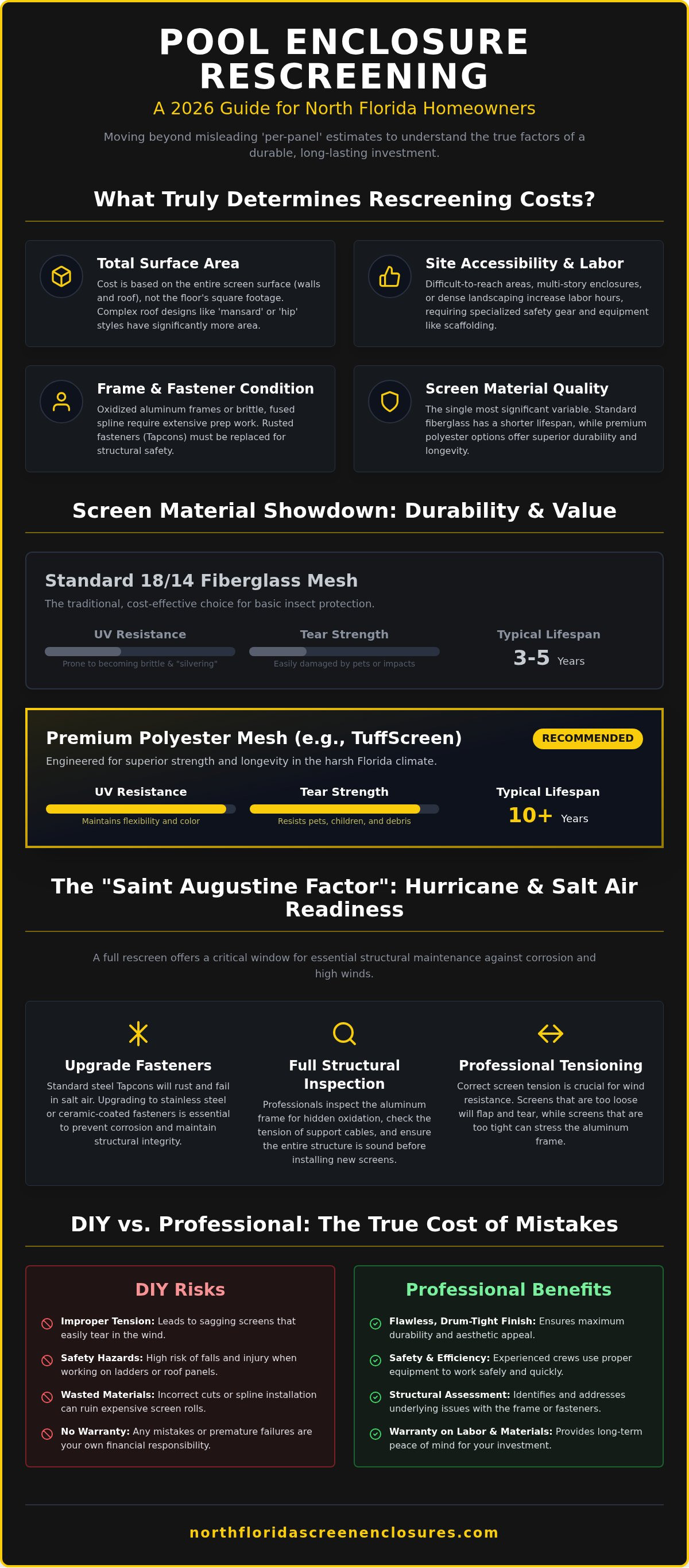
When homeowners begin researching the cost to rescreen pool cage Florida projects, they often encounter "per panel" estimates. This metric is frequently misleading. A single panel on a small side wall requires far less labor and material than a large, high-reach roof panel on a multi-story Lanai. Professional contractors focus on a comprehensive scope that includes labor, material quality, and site accessibility. If your cage is tucked between a lake and a dense landscape, the increased difficulty in positioning ladders or scaffolding adds to the total labor hours.
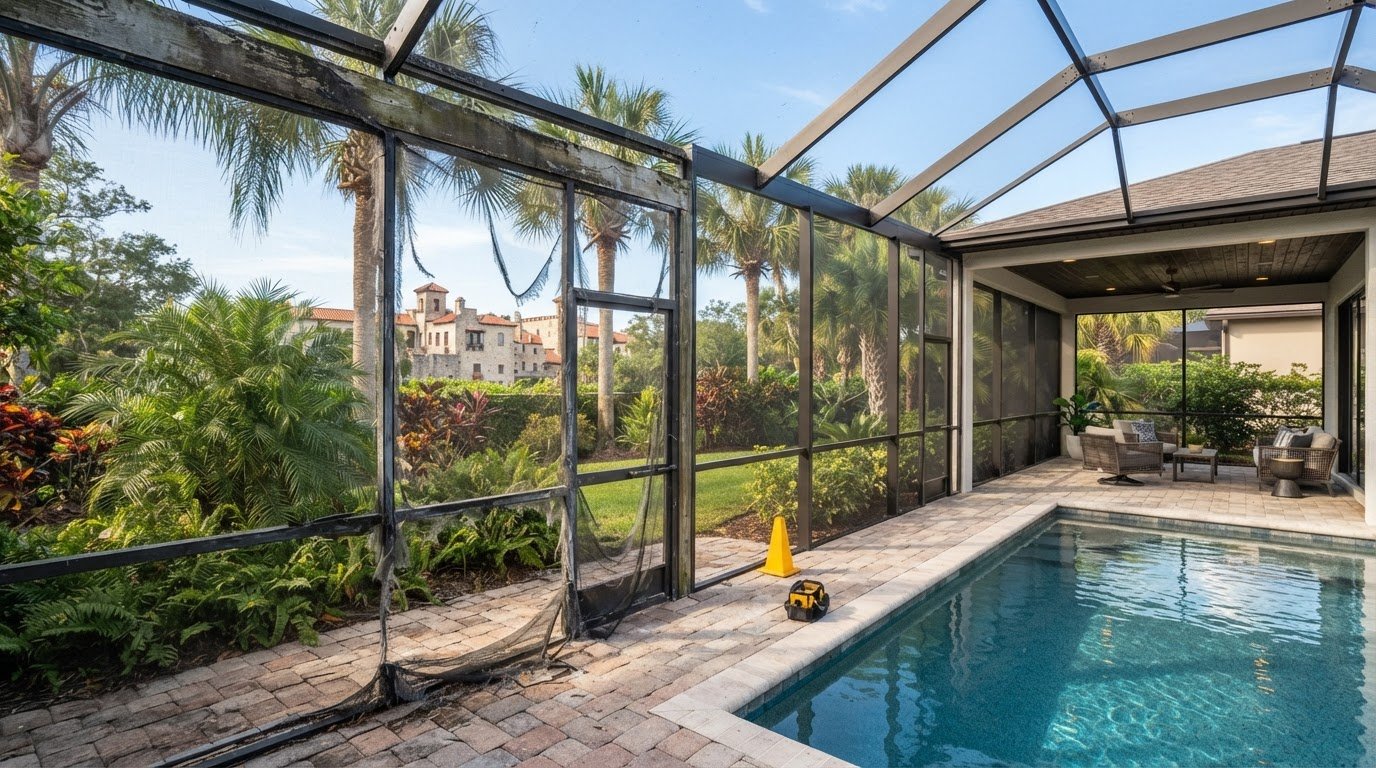
Beyond the physical dimensions, the condition of your existing structure plays a vital role. If the aluminum frame has significant oxidation or if the old spline has become brittle and fused to the metal, the prep time increases. A diligent craftsman must clean these grooves thoroughly to ensure the new screen stays tensioned and secure. This preparation phase is where many "fly-by-night" contractors cut corners, leading to screens that pop out during the first strong summer storm.
The Square Footage vs. Surface Area Calculation
It's a common mistake to estimate costs based on the square footage of the pool deck. In reality, rescreening involves the total surface area of every wall and roof section. A cage with a "mansard" or "hip" roof has more surface area than a flat-roof design. Tall walls or two-story enclosures require specialized safety gear and more technicians, which naturally influences the project timeline. We calculate the ratio of roof panels to wall panels because roof sections typically endure the most UV damage and require more precision to install correctly.
Standard vs. Premium Mesh Options
The material you select is the most significant variable in determining the cost to rescreen pool cage Florida homeowners face. Standard 18/14 fiberglass mesh is the traditional choice. It's cost-effective and provides basic protection, but it typically has a shorter lifespan in the intense Florida sun. Over time, fiberglass becomes brittle and easy to tear.
Polyester options, often referred to as "TuffScreen," offer much higher durability. These materials are nearly impossible to tear and are specifically engineered to withstand the intense UV rays and salt air found in Saint Augustine. While the upfront investment is higher, the longevity often justifies the price. Specialty options like "No-See-Um" mesh utilize a tighter weave to block tiny insects, while "Florida Glass" or privacy screens provide a laminated barrier for areas where you want to block the view of neighbors or debris.
Comparing Screen Materials: Durability and Value in 2026
The landscape of screen technology has shifted significantly in recent years. By 2026, the materials available for pool enclosures are far more resilient than the legacy mesh used a decade ago. The primary culprit for screen failure in North Florida isn't just high wind; it's the relentless UV exposure that degrades standard fiberglass. This radiation causes the material to become brittle, eventually leading to the "silvering" effect where the screen turns white and tears under minimal pressure.
Premium polyester materials have revolutionized the industry by offering a much higher break strength compared to traditional fiberglass. While standard 18/14 mesh serves its purpose for basic bug protection, polyester-based products are engineered to withstand the constant thermal expansion and contraction common in our coastal climate. When homeowners evaluate the cost to rescreen pool cage Florida projects, they often discover that investing in higher-grade materials significantly reduces the long-term maintenance burden. Properly calculating the cost to rescreen pool cage Florida residents pay requires comparing these material lifespans against the initial labor investment.
TuffScreen and Pet-Resistant Mesh
For families with active pets or young children, puncture-resistant mesh is a vital investment. These heavy-duty polyester screens are specifically designed to resist claws and accidental impacts that would easily shred standard fiberglass. Most premium polyester options now carry a 10-year warranty, which offers a level of reassurance that standard materials cannot match. In the Saint Augustine real estate market, a "TuffScreen" enclosure is a recognized asset. Buyers value these high-performance solutions because they signal a well-maintained home. Before committing to a material upgrade, it's wise to verify a contractor's license to ensure the installation meets current safety standards.
No-See-Um and Privacy Screens
Homeowners living near marshes or coastal inlets often face challenges with tiny biting insects. While standard 18/14 mesh effectively blocks mosquitoes, a tighter 20/20 "No-See-Um" mesh is necessary to stop smaller pests. There is a slight trade-off in airflow and visibility due to the denser weave, but the increased comfort usually outweighs these factors. For those seeking more seclusion, "Florida Glass" is a specialized laminated screen often installed on lower panels. It creates a solid privacy barrier and prevents lawn debris or mulch from entering the pool area. If you're ready to upgrade your outdoor living space, a professional complete re-screen can transform your enclosure into a more functional environment.
Florida-Specific Variables: Salt Air, Wind, and Structural Integrity
Living in Saint Augustine means dealing with the "Saint Augustine Factor." Salt spray doesn't just sit on the mesh; it migrates into the aluminum channels and settles on the fasteners. This environment creates a chemical reaction that accelerates the decay of the hardware holding your cage together. When evaluating the cost to rescreen pool cage Florida homeowners often overlook the "skeleton" of the structure. A quote that only covers mesh is often a red flag. If the aluminum frame is unstable or the fasteners are failing, new mesh will likely tear prematurely during the first strong summer storm.
The 2026 standards for coastal resilience are more stringent than ever. Adhering to the Florida Building Code for screen enclosures ensures that your structure can withstand specified wind loads and pressure. During a complete re-screen, a specialist should inspect the structural cables and tie-downs. These components provide the tension necessary to keep the aluminum members from buckling under stress. Ignoring these hidden elements during a rescreen is a missed opportunity to ensure your enclosure remains hurricane-ready.
The Critical Role of Tapcon Replacement
Tapcons are the specialized fasteners that anchor your aluminum enclosure into the concrete pool deck. In North Florida, the combination of high humidity and salt air causes standard steel fasteners to oxidize and "rust out" over several years. A rusted Tapcon loses its structural grip, meaning your entire cage could shift or lift during a tropical storm. Integrating tapcon replacement for pool cages into your project is a practical way to restore the bond between the metal and the ground. It's a technical upgrade that provides long-term peace of mind for the safety of your family.
Cable Tensioning and Perimeter Inspection
New mesh requires a stable frame to maintain proper tension. Loose or snapped structural cables cause the frame to wobble, which puts uneven stress on the spline and leads to early failure. Before installing new material, we inspect the spline channels for debris and corrosion. If these tracks are clogged or pitted, the screen won't seat properly, leading to the mesh popping out. We also check door hardware and closers. A pool cage serves as a vital safety barrier; ensuring your doors self-close and latch correctly is essential for staying compliant with local safety regulations. This thorough approach ensures the total cost to rescreen pool cage Florida projects reflects a safe, durable result.
DIY vs. Professional Rescreening: The True Cost of Mistakes
The temptation to handle a rescreening project as a weekend DIY task is understandable, especially when homeowners are looking to manage the total cost to rescreen pool cage Florida projects. However, the technical difficulty of the job often surprises those without professional experience. Achieving the correct tension across a large roof panel is a precise skill. If the mesh is pulled too tight, it creates an "hourglass" effect where the aluminum members are actually pulled inward, potentially warping the frame. Conversely, screens that are too loose will sag and flutter, which leads to premature wear and a noisy environment during windy days.
Safety remains the most significant concern for the average homeowner. Working on the high-pitch roof of a pool cage requires specialized staging equipment and walk boards to distribute weight evenly. Without professional gear, you risk damaging the aluminum structure or, more importantly, suffering a serious fall. A professional team arrives with the necessary safety harnesses and experience to navigate these heights safely. When you calculate the cost to rescreen pool cage Florida enclosures, you must factor in the price of purchasing specialty tools like high-leverage spline rollers, precision cutters, and the ladders required for multi-story cages.
Why Proper Tensioning Matters
Improper tensioning doesn't just look bad; it compromises the structural integrity of the enclosure. Over-tensioning can pull the cage out of square, making doors difficult to latch and creating gaps where bugs can enter. Baggy screens are equally problematic as they catch more wind and collect debris like pine needles and oak leaves. Professional spline installation ensures the mesh is seated deep within the groove, preventing the screen from pulling out during the high-pressure wind events common in Florida. This level of precision is difficult to replicate with consumer-grade tools.
The Value of a Comprehensive Service
A professional service offers much more than just new mesh. A complete re-screen includes a thorough inspection of the entire structure, identifying issues that a DIYer might miss. Professionals handle the labor-intensive task of removing and disposing of the old, brittle mesh, which can be a significant logistical challenge for a homeowner. Most importantly, a licensed contractor provides insurance and liability coverage. This protection ensures that any accidental damage to your property or injuries on the job site are covered, providing a level of peace of mind that a DIY project cannot offer. If you want to ensure your enclosure is restored to a professional standard, you can request a quote for a complete re-screen today.
Choosing a North Florida Contractor for Your Rescreen
Selecting the right professional is as critical as the mesh you choose. In Saint Augustine, a contractor's familiarity with coastal building codes and environmental stressors is non-negotiable. When evaluating the cost to rescreen pool cage Florida homeowners often find that the most comprehensive quotes include more than just labor and mesh. They include the expertise required to navigate the 2026 Florida Building Code and the specific wind-load requirements for our region. A seasoned specialist understands that a pool cage is a structural system, not just a series of screen panels.
The lowest bid often results in a "splash-and-dash" job where the contractor replaces the mesh but ignores the corroding hardware underneath. This approach might save money today, but it increases the likelihood of frame failure during the next tropical event. A professional quote should be transparent and detailed, providing a clear roadmap of the work to be performed and the specific materials being used to ensure the longevity of your investment.
Red Flags in a Rescreening Estimate
Be wary of estimates that use generic terms like "standard screen" without specifying a manufacturer or mesh density. A professional quote should be transparent and detailed. Watch for these common red flags when reviewing your options:
Vague material descriptions: Quotes that don't specify UV resistance, brand names, or warranty terms.
Omitted inspections: Estimates that fail to mention the condition of fasteners, structural cables, or tie-downs.
Lack of local presence: Contractors without a physical local address or a verifiable Saint Augustine presence may be difficult to reach for warranty issues.
Suspiciously low pricing: Bids that are significantly lower than the market average often indicate that the contractor is cutting corners on labor-intensive structural checks.
The North Florida Screen Enclosures Standard
At North Florida Screen Enclosures, we view a complete re-screen as a total restoration of your enclosure's integrity. We exclusively use premium materials designed to thrive in the harsh coastal climate of Northeast Florida. Our process isn't just about aesthetics; it's about structural permanence and providing a safe environment for your family. We focus on the details that "fly-by-night" operations ignore, from proper spline seating to frame alignment.
Every project we undertake includes a "Structural Health Check." This ensures that the aluminum frame, fasteners, and tensioning cables are all functioning as a cohesive system to protect your pool area. If you're concerned about the current state of your enclosure, contact us for a professional pool enclosure repair St. Augustine consultation. We take pride in delivering results that stand up to the sun, salt, and wind, ensuring the total cost to rescreen pool cage Florida you pay translates into years of worry-free outdoor living.
Investing in Long-Term Coastal Resilience
A successful pool cage restoration in North Florida requires a balance of high-performance materials and structural precision. The cost to rescreen pool cage Florida homeowners pay is determined by more than just square footage; it's a strategic investment in the longevity of your outdoor living space. By prioritizing 2026 mesh technology and addressing the underlying health of your aluminum frame, you ensure your enclosure remains a safe, bug-free sanctuary even during demanding weather events.
Don't settle for a quote that ignores the critical hardware holding your structure together. At North Florida Screen Enclosures, we're specialists in Saint Augustine's coastal requirements. We offer high-durability mesh options and include expert hardware and Tapcon replacement to provide a truly complete service. We handle the technical details so you can return to enjoying your environment with confidence. Request a Professional Rescreening Estimate from North Florida Screen Enclosures today to secure your home with local expertise. Your peace of mind starts with a structure built to endure.
Frequently Asked Questions
How much does it cost to rescreen a pool cage per square foot in Florida?
Rescreening costs are calculated based on the total surface area of the mesh rather than the square footage of the pool deck. While industry averages for material and labor exist, the final investment depends on the cage's height and roof complexity. Factors like site accessibility and the current condition of the frame's channels also influence the project scope. We provide detailed estimates that reflect the specific technical requirements of your Saint Augustine home.
Is it cheaper to rescreen individual panels or the whole cage?
Replacing the entire cage is more cost-effective in the long run than repairing individual panels. Single-panel repairs involve higher per-unit labor costs due to mobilization and setup time. Additionally, once a few panels begin to fail, it's often a sign that the remaining mesh has reached its UV-degradation limit. A complete re-screen ensures uniform tension across the structure and allows for a comprehensive inspection of all structural hardware.
How long does a typical pool cage rescreen take to complete?
Most standard-sized pool cage rescreening projects in Saint Augustine are completed within one to three days. The exact timeline depends on the size of the enclosure, the number of technicians on-site, and the complexity of the roofline. Weather conditions, particularly high winds or heavy rain, can occasionally impact the schedule. We prioritize a methodical approach to ensure every panel is correctly tensioned and all structural fasteners are properly secured.
What is the best type of screen for Florida pool enclosures?
High-performance polyester mesh is widely considered the superior choice for the North Florida climate. Unlike traditional fiberglass, premium polyester offers exceptional UV resistance and higher break strength, which is essential for hurricane resilience. For homeowners near the coast, we often recommend materials like TuffScreen for their longevity. If you're calculating the cost to rescreen pool cage Florida projects, investing in these durable materials significantly extends the time between necessary replacements.
Do I need a permit to rescreen my pool cage in Saint Augustine?
In most cases, a simple rescreening of an existing structure doesn't require a new building permit in Saint Augustine or St. Johns County. However, if the project involves structural modifications, such as replacing aluminum members or changing the cage's footprint, a permit is mandatory. We stay updated on the latest local building codes to ensure all work remains compliant. It's always best to verify specific requirements with your contractor before starting a major restoration.
How often should a Florida pool cage be rescreened?
A standard fiberglass screen typically lasts between seven and ten years in the intense Florida sun. If you notice the mesh turning silver, becoming brittle, or tearing easily, it's time for a professional update. Premium polyester materials can last significantly longer, often exceeding fifteen years with proper care. Regular maintenance, such as rinsing off salt spray and inspecting for loose spline, helps maximize the lifespan of your enclosure's mesh and structural hardware.
Will rescreening my pool cage help with hurricane protection?
Rescreening itself doesn't make the aluminum frame hurricane-proof, but it provides a critical opportunity to restore structural integrity. During the process, we inspect and replace corroded Tapcons and tensioning cables that are vital for wind resistance. New mesh installed with professional tensioning also reduces the risk of panels "blowing out" and creating dangerous pressure imbalances. A complete re-screen ensures the entire system is prepared to handle the stresses of a tropical storm.
Can I change my screen type during a rescreen, such as to a pet-resistant mesh?
Upgrading your material is a common part of the cost to rescreen pool cage Florida homeowners plan for. You can choose to install pet-resistant mesh on lower panels to prevent damage from claws while using high-visibility mesh for the upper sections. Other options include No-See-Um mesh for insect protection or Florida Glass for added privacy. We help you select the right combination of materials to enhance your outdoor living environment.
Comments