


Aluminum Railing Maintenance in Florida: The Complete 2026 Homeowner’s Guide

In the salt-heavy air of coastal Florida, "low-maintenance" aluminum doesn't mean "zero-maintenance." While your railing is built to withstand the elements, the combination of intense humidity and corrosive sea spray can eventually compromise even the toughest powder coating. You may have already noticed a white, chalky oxidation appearing on your posts or seen rust stains bleeding from the Tapcon fasteners at the base of your balcony. These aren't just cosmetic issues; they're early warning signs that the coastal environment is working against your home's structural integrity.
We understand that you chose aluminum for its resilience and long-term value. This guide provides the expert aluminum railing maintenance Florida homeowners need to stop corrosion in its tracks and preserve that factory-fresh finish. We'll walk you through a professional-grade cleaning schedule, identify the specific products that are safe for your finish, and explain when it's time to bring in a specialist for fastener replacement or structural repairs. By following these proactive steps, you can ensure your investment remains a durable and beautiful part of your home for years to come.
Table of Contents
Why Florida’s Coastal Climate Demands Specific Aluminum Railing Care
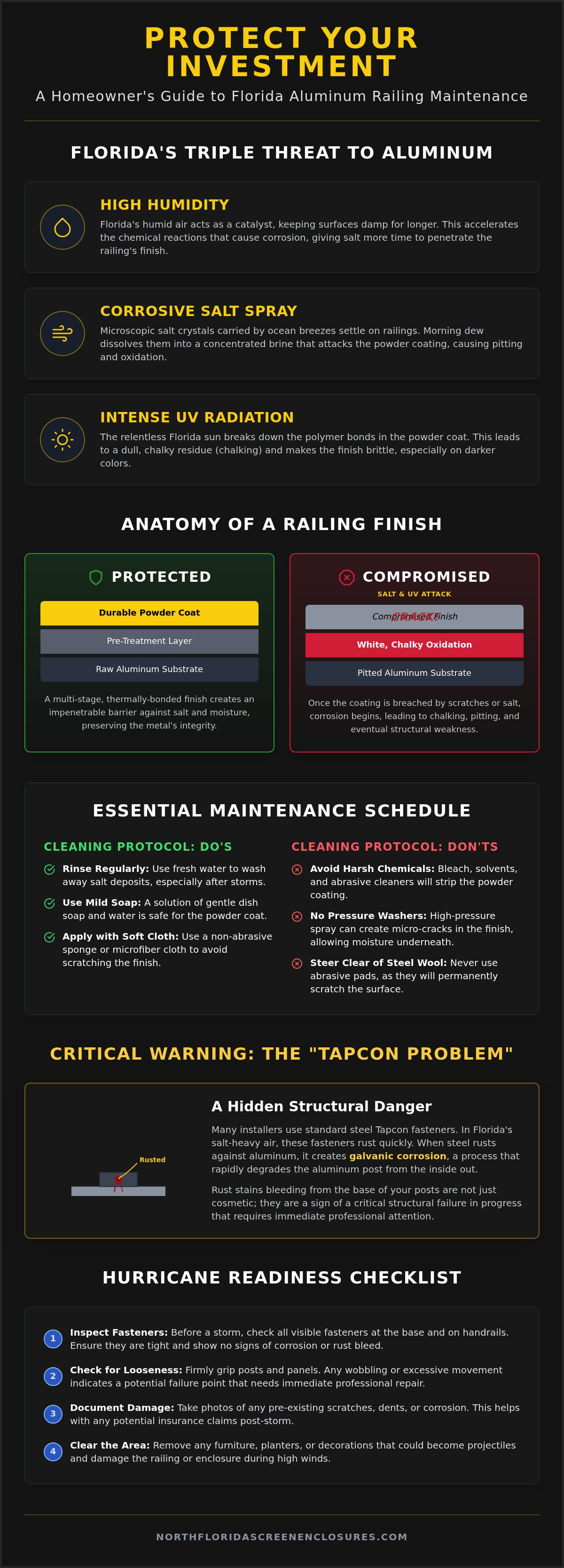
Florida's environment is beautiful, but it is also one of the most corrosive landscapes in North America. For homeowners along the coast, aluminum railing maintenance Florida requires a specialized approach because of the "Critical Salt Zone." If your property is located within zero to five miles of the ocean, your railings are under constant chemical attack. Salt air and high humidity don't just sit on the surface; they work in tandem to find any weakness in the protective finish. North Florida’s high humidity acts as a catalyst, keeping surfaces damp for longer periods and giving corrosive elements more time to react with the metal.
The Role of Salt Spray in St. Augustine
In St. Augustine, the Atlantic breeze carries more than just a cool wind; it transports microscopic salt crystals that act as a persistent abrasive on your outdoor structures. These crystals settle into every corner of your railing system. The real damage happens during the "wet-dry" cycle. Every morning, heavy humidity and dew dissolve these salt deposits, turning them into a concentrated brine. As the temperature rises and the moisture evaporates, the salt recrystallizes. This expansion can create tiny cracks in the powder coating, eventually leading to pitting. This process challenges the protective oxide layer that naturally forms on the metal. Once the salt reaches the raw aluminum, oxidation begins to manifest as white, crusty spots that are difficult to remove without professional intervention.
UV Exposure and Powder Coat Fading
While salt is the chemical enemy, the Florida sun is the mechanical one. UV radiation acts as a silent killer of railing aesthetics through a process known as chalking. The intense ultraviolet rays break down the polymer bonds within the powder coating. This degradation turns the once-smooth finish into a dull, chalky residue that rubs off on your hands or clothing. Darker railing colors, such as black or deep bronze, are at the highest risk. These shades absorb significantly more heat, which increases the thermal expansion and contraction of the metal. This constant movement, combined with high UV exposure, causes the finish to become brittle over time. Maintaining the structural integrity and the visual appeal of your property means understanding that these environmental factors are always at play. Consistent aluminum railing maintenance Florida homeowners perform is the only way to counteract this daily wear and tear.
The Science of Aluminum Protection: Powder Coating vs. Oxidation
Aluminum is widely celebrated for its resistance to rust, but in Florida's aggressive climate, "rust-proof" does not mean "maintenance-free." While aluminum won't develop the red iron oxide seen in steel, it is susceptible to its own form of corrosion. When raw aluminum is exposed to the elements, it reacts with oxygen to create a thin, dull grey layer. In a controlled environment, this layer is helpful. However, in the high-salinity air of the coast, chloride ions from sea salt penetrate this layer, leading to pitting and structural weakening. This is why a high-quality physical barrier is essential for long-term aluminum railing maintenance Florida homeowners can rely on.
Powder coating provides this necessary shield. Unlike liquid paint, which dries through evaporation, powder coating is electrostatically applied and then cured under intense heat. This process creates a thermal bond, resulting in a finish that is significantly harder and more durable than traditional paint. Without this chemically bonded layer, your railing is vulnerable to filiform corrosion. This specific threat manifests as thin, thread-like filaments creeping beneath the finish. It usually starts at a small scratch or an unprotected edge, eventually lifting the coating and exposing the metal to rapid decay.
Anatomy of a High-Quality Railing Finish
The durability of your railing is determined long before the final coat is applied. Professional-grade aluminum undergoes a multi-stage pre-treatment process, including acid washes and conversion coatings, to ensure the powder adheres at a molecular level. Homeowners should look for "mil" specifications, which indicate the thickness of the coating. While a standard 2 to 3 mil thickness is common, coastal installations often require higher specifications to withstand abrasive wind-blown sand. High-quality powder coating provides a robust, chemically bonded shield that prevents saltwater from reaching the raw aluminum substrate.
Identifying Structural vs. Cosmetic Issues
Understanding the difference between a surface blemish and a structural failure is vital for property safety. Cosmetic issues, like surface dirt or the "chalking" caused by UV rays, can typically be resolved with a thorough rinse. Structural threats are different. If you notice the finish bubbling, cracking, or peeling away in large flakes, you are witnessing delamination. This means the protective bond has failed, leaving the metal beneath it defenseless.
You can perform a simple adhesion test on an inconspicuous area by applying high-tack tape and pulling it away firmly. If the coating remains intact, the bond is still healthy. If pieces of the finish pull away, the integrity of the barrier is compromised. For those managing multi-story balconies, scheduling a professional safety audit is a proactive way to ensure these hidden failures don't lead to a dangerous structural collapse.
The Ultimate Florida Aluminum Railing Cleaning Schedule
Many homeowners assume aluminum is a "set it and forget it" material. In Florida, that's a mistake that leads to premature failure. Effective aluminum railing maintenance Florida starts with a simple, consistent routine. You don't need expensive chemicals or industrial equipment. In fact, aggressive cleaning agents often do more harm than good by stripping the protective wax or etching the powder-coated surface. Stick to the "Mild Soap and Water" rule. Use a non-detergent soap, like a basic dish liquid, diluted in a bucket of warm water. Avoid abrasive pads or steel wool; these create micro-scratches that invite filiform corrosion.
Pressure washing is a common temptation, but it's risky. High-pressure jets can force water into joints or blast away the finish if there's a pre-existing nick. A garden hose with a standard spray nozzle and a soft-bristle brush are your most effective tools. Pay special attention to the underside of the rails and the joints where the pickets meet the frame. These are "salt traps" where corrosive crystals hide from the rain. They require manual agitation to ensure the brine is fully displaced.
Monthly Maintenance for Beachfront Homes
If you live within sight of the Atlantic, your maintenance schedule must be more aggressive to combat the daily salt accumulation discussed earlier. A monthly routine prevents salt from bonding to the finish.
Step 1: Freshwater Rinse. Use a garden hose to thoroughly rinse the entire system. This removes loose salt crystals before they can act as an abrasive during the wipe-down.
Step 2: Gentle Wipe-Down. Using a soft cloth or sponge and your mild soap solution, wipe down all surfaces. Focus on the base plates and the areas closest to the ground where salt-laden soil splashes up.
Step 3: Final Rinse and Inspection. Rinse again to ensure no soap residue remains, as dried soap can attract more dirt. Take this moment to check connection points for any signs of loosening or early pitting.
Bi-Annual Deep Cleaning for Inland Properties
Even if you're a few miles inland, North Florida’s humidity fosters organic growth. Mildew and algae can thrive in the shade of oaks or on the north-facing side of your balcony. A deep clean every six months keeps these issues in check.
Remove Organic Growth. A solution of one part white vinegar to three parts water is usually enough to kill mildew without damaging the finish. Apply it with a sponge, let it sit for a few minutes, then scrub gently.
Apply Automotive-Grade Wax. Once the railing is clean and dry, apply a high-quality automotive-grade car wax. This adds an extra layer of UV protection and helps water bead off the surface, significantly extending the life of the powder coating.
Clear Drainage Holes. Most aluminum posts have small weep holes at the base. Ensure these aren't clogged with dirt or mulch. Blocked holes allow water to sit inside the post, leading to internal oxidation that you won't see until it's too late.
Troubleshooting Common Railing Issues: Fasteners and Scratches
Even the most diligent cleaning routine cannot prevent the physical impact of daily life. Scratches from patio furniture or the slow degradation of anchoring hardware are inevitable. Effective aluminum railing maintenance Florida homeowners must practice involves regular mechanical inspections to identify these issues before they compromise the safety of your deck or balcony. Understanding the difference between a simple fix and a structural hazard is the hallmark of a responsible property owner who values long-term investment protection.
Fastener Integrity and Tapcon Replacement
The most common point of failure in Florida railing systems isn't the aluminum itself; it's the fasteners. Standard steel Tapcons used to anchor railing posts into concrete slabs are highly susceptible to salt-induced corrosion. As these fasteners rust, they expand. This process, known as oxide jacking, can actually crack the surrounding concrete and loosen the entire structure. If you see orange streaks bleeding from the base of your posts, you need to address it immediately. Our team specializes in tapcon replacement for pool cages and balcony railings to restore structural stability. For coastal repairs, utilizing 304 or 316-grade stainless steel fasteners is mandatory to prevent a recurrence of the problem.
Repairing Surface Damage
When the powder coating is breached by a deep scratch, the clock starts ticking. Raw aluminum will begin to oxidize, and filiform corrosion can begin to travel under the surrounding finish. To repair this, start by lightly sanding the area with fine-grit sandpaper to remove any loose debris or early oxidation. Apply a high-quality primer designed for aluminum to seal the metal. When it comes to the topcoat, matching the manufacturer's specific color code is vital. Generic paints often have different gloss levels or UV stabilizers, which will result in an obvious, patchy appearance once dry. Properly sealing these scratches is a core part of aluminum railing maintenance Florida residents use to keep their homes looking professional and well-kept.
A wobbly handrail or a rattling picket is often a sign of loose internal screws or a compromised base plate. If the damage is limited to a few fasteners or surface scratches, a repair is a cost-effective way to extend the life of your system. However, if the base of the aluminum post has become thin from years of neglect, or if the concrete has spalled significantly, a full replacement is the only safe option. If you aren't sure about the stability of your system, you should schedule a professional railing safety audit to get a clear picture of your repair options before the next storm season arrives.
Professional Maintenance and Hurricane Readiness
Living in Northeast Florida means accepting the reality of the Atlantic hurricane season, which officially runs from June 1 through November 30. For homeowners, aluminum railing maintenance Florida isn't just about preserving a finish; it's a critical component of storm preparedness. High winds exert tremendous pressure on outdoor structures. A railing that feels stable during a summer breeze can become a liability when subjected to the sustained gusts of a tropical system. Professional oversight ensures that every component of your railing system is prepared to withstand the environmental stressors unique to our region.
Structural compliance is non-negotiable for safety and insurance purposes. North Florida Screen Enclosures specializes in verifying that your installations meet the 2026 Florida Building Code standards. This includes confirming proper guardrail heights and ensuring that the structural attachment to the building remains sound. Over time, even the best installations can settle or experience fastener fatigue. A professional safety audit identifies these hidden risks before they manifest during a storm event.
Preparing Railings for High-Wind Events
Before the peak of the storm season, conduct a thorough walkthrough of your property. Focus on the following areas to minimize wind-related damage and ensure your home remains secure:
Anchor Point Inspection. Check the base plates of every post. If you see cracks in the concrete or signs of fastener corrosion, the structural integrity is already compromised.
Soffit and Fascia Security. Ensure the soffit and fascia around your railing and enclosure are tightly secured. Loose panels can catch the wind and create a chain reaction of structural failure.
Debris Removal. Remove any temporary attachments, such as privacy screens, banners, or hanging plants. These items act as sails, significantly increasing the wind load on the railing pickets and posts.
The Benefits of Professional Maintenance Plans
A proactive maintenance plan can extend the life of your aluminum structures by decades. While seasonal cleaning is vital, professional technicians can identify microscopic signs of delamination or internal oxidation that most homeowners miss. Beyond longevity, there is the issue of liability. In St. Johns County, railings must meet specific safety codes for height and picket spacing. Ensuring your home is up to date protects both your guests and your financial interests. If your finish has reached the end of its life cycle, we can guide you through the decision to re-coat or upgrade to a modern, hurricane-rated system. Contact North Florida Screen Enclosures for a railing inspection today!
Protecting Your Coastal Investment for the Long Term
Maintaining the beauty and safety of your home doesn't have to be an overwhelming task. By implementing a consistent schedule for aluminum railing maintenance Florida, you can effectively combat the corrosive effects of salt air and intense UV radiation. We've discussed the importance of using gentle cleaning methods to preserve your powder coating and the critical need to inspect fasteners like Tapcons for signs of "oxide jacking." These small, proactive steps ensure your railings remain a durable asset rather than a structural liability.
As St. Augustine's trusted aluminum specialists, North Florida Screen Enclosures is dedicated to high-quality workmanship and hurricane-rated construction standards. Whether you need expert Tapcon and fastener replacement or a comprehensive safety audit, our team is here to provide the peace of mind you deserve. Don't wait for the next storm season to uncover hidden weaknesses in your balcony or deck enclosure. Request a Free Railing Inspection in Saint Augustine today to secure your property. Your home is a significant investment; let's work together to keep it resilient and beautiful for decades to come.
Frequently Asked Questions
How often should I clean my aluminum railings in Florida?
You should rinse your railings at least once a month if you live within five miles of the Saint Augustine coast. For properties located further inland, a thorough cleaning every six months is usually sufficient. Regular freshwater rinsing is the most effective way to prevent salt crystals from bonding to the finish and causing permanent pitting. Consistent cleaning is a fundamental part of aluminum railing maintenance Florida homeowners must prioritize to protect their investment.
Can I use a pressure washer on my powder-coated railings?
We generally advise against using a pressure washer because the intense force can compromise the thermal bond of the powder coating. High-pressure jets can also drive moisture into joints or weep holes, leading to internal corrosion that is difficult to detect. A standard garden hose paired with a soft-bristle brush is much safer. This method effectively removes surface contaminants without risking the structural integrity of the finish or the fasteners.
Why is my aluminum railing turning white and chalky?
This white, chalky residue is typically caused by UV degradation of the powder coating's polymer bonds, a process known as chalking. It can also indicate surface oxidation where salt has begun to react with the metal. Implementing a proactive routine for aluminum railing maintenance Florida residents trust, including the application of an automotive-grade wax, can help block these UV rays. Regular rinsing also prevents salt from sitting on the surface and accelerating this breakdown.
What are the best cleaning products for coastal aluminum?
The safest and most effective cleaning solution is a simple mixture of mild, non-detergent soap and warm water. Avoid using abrasive cleaners, bleach, or industrial solvents, as these can etch the powder-coated surface and strip away protective layers. For an added layer of defense against the Saint Augustine sun, apply a high-quality car wax after the railing is dry. This helps water bead off and provides a sacrificial barrier against salt spray.
Are aluminum railings really maintenance-free in St. Augustine?
While aluminum is incredibly durable, it is not entirely maintenance-free in our coastal environment. The term "low-maintenance" is more accurate for Saint Augustine properties because the salt air is highly corrosive. Without periodic rinsing and inspections, even the best powder-coated systems can eventually succumb to oxidation or fastener failure. Minimal effort spent on cleaning today prevents the need for expensive structural repairs or full replacements several years down the road.
How do I know if my railing fasteners need to be replaced?
You should inspect the base of your railing posts for orange rust stains or "bleeding" onto the concrete. Since aluminum does not rust, these stains indicate that the steel Tapcon fasteners are corroding. If the fasteners look heavily pitted or if the post feels loose when you apply pressure, they have likely lost their structural grip. Professional Tapcon replacement is necessary to ensure the railing remains safe and code-compliant for your family.
Can I paint over my existing powder-coated aluminum railing?
It is possible to paint over powder coating, but it requires meticulous surface preparation to ensure the new layer adheres correctly. You must lightly sand the existing finish and apply a specialty primer designed specifically for aluminum substrates. Keep in mind that a standard paint job will never be as durable as the original factory-applied powder coat. For the best results in our humid climate, matching the manufacturer's original specifications is vital.
What should I do if I see rust on my aluminum railing base?
If you see rust at the base of your railing, it is almost certainly the steel anchoring hardware failing rather than the aluminum itself. This is a common issue in Saint Augustine where salt-laden moisture collects at ground level. You should contact a specialist to assess the damage and perform a professional Tapcon replacement. Replacing these rusted screws with coated or stainless steel alternatives will stop the corrosion and restore the railing's stability.
Comments