


Concrete Patio Cost in Florida: 2026 Pricing & Comparison Guide

A concrete patio in Florida is far more than a simple outdoor surface; it's a structural foundation that must be engineered to withstand shifting coastal soils and intense seasonal rains. While many homeowners start their research by looking for a basic estimate, the true concrete patio cost Florida residents encounter is shaped by site-specific preparation and long-term durability requirements. You're likely concerned about the potential for cracking or the complexity of local permitting, and you want to ensure your investment can support a future screen enclosure or elite roofing system without failing.
We understand that a home project is a significant commitment of both time and resources. This guide provides a transparent framework for 2026 pricing, moving past generic estimates to focus on the technical realities of North Florida construction. You'll discover how professional grading prevents drainage issues, which decorative finishes offer the best return on investment, and why the right thickness is critical for structural integrity. By the end of this comparison, you'll have the technical knowledge to choose a patio solution that offers both immediate beauty and permanent peace of mind.
Table of Contents
Decoding Concrete Patio Cost in Florida for 2026
Concrete remains the primary choice for Florida homeowners due to its versatility and structural permanence. When estimating the concrete patio cost Florida property owners encounter in 2026, it's essential to look beyond the raw material. The total investment reflects a combination of fluctuating supply chain logistics, specialized local labor, and the specific engineering required for our sandy, coastal environment. While a standard broom-finish surface is often the entry point, the final quote is heavily influenced by the accessibility of your backyard and current fuel surcharges for heavy machinery delivery.
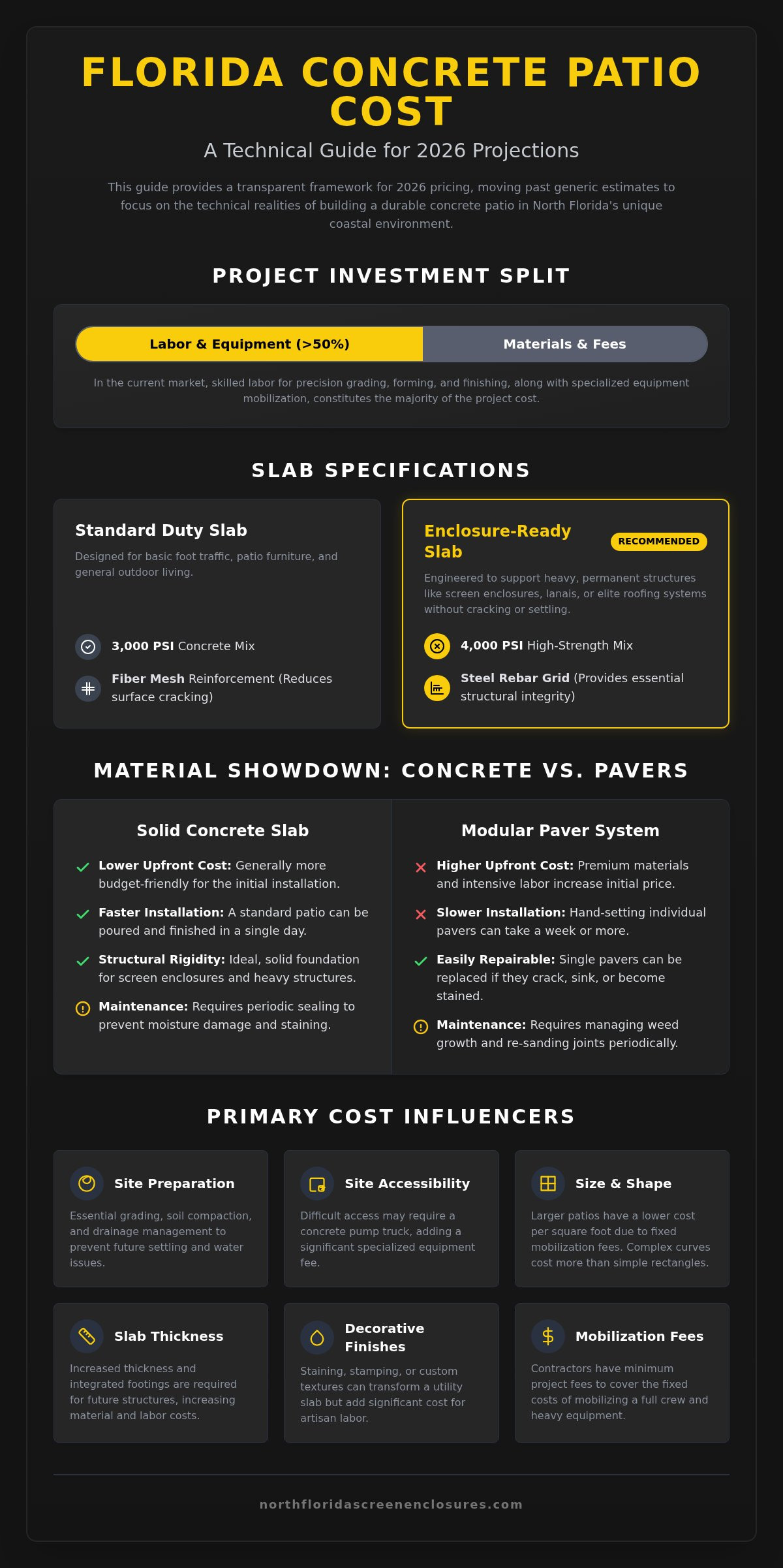
Typically, the budget for a professional installation is divided between raw materials and skilled labor. In the current 2026 market, labor represents more than half of the total project investment, as contractors must account for the precision required in grading and forming. Delivery fees have also seen adjustments due to rising transportation costs, and many North Florida specialists now implement a minimum project fee. This ensures that even for a small extension, the mobilization of a full crew and heavy equipment remains economically viable for the contractor. These mobilization costs are fixed regardless of the slab size, which is why larger patios often provide better value per square foot.
The Baseline: Standard vs. Reinforced Slabs
Choosing the right mix is the first step in ensuring long-term value. A standard 3,000 PSI mix might suffice for basic foot traffic, but we often recommend a 4,000 PSI high-strength blend for patios intended to support future structures. Reinforcement is another critical factor. While some builders use basic fiber mesh to reduce surface cracking, traditional rebar grids provide the structural skeleton necessary for Florida's shifting soil. This reinforcement is a non-negotiable for coastal properties. It's especially vital if you plan to eventually add a pool enclosure or an elite roofing system, as the slab must bear significant weight without settling or tilting.
Labor and Installation Dynamics in North Florida
Regional dynamics in areas like St. Augustine and Palm Coast play a major role in the concrete patio cost Florida contractors must calculate. Labor rates can vary based on the proximity to major supply hubs in Jacksonville. Additionally, site accessibility is a major cost driver. If a concrete pump truck is required because a standard mixer cannot reach your backyard, this adds a specialized equipment fee to the total. Professional finishers also command a premium. Their ability to manage the "set time" in Florida's high humidity ensures the surface is smooth, level, and free of premature curing defects that could lead to scaling later.
Concrete vs. Pavers: A Long-Term Cost-Benefit Analysis
Deciding between a solid slab and a modular paver system requires a look at both the immediate budget and the ten-year maintenance forecast. While the initial concrete patio cost Florida residents pay is often lower than premium paver installations, the trade-off lies in how each material handles the inevitable movement of our sandy substrate. A monolithic concrete slab provides a rigid, uniform surface that's ideal for supporting heavy structures. However, it lacks the modular flexibility of pavers when the ground shifts significantly over time.
Upfront Costs and Installation Speed
Concrete installation is a methodical process that prioritizes efficiency once the forms are set. Pouring a slab usually takes a single day, whereas hand-setting thousands of individual bricks is a labor-intensive endeavor that can span a week or more. In the 2026 construction market, material lead times for custom paver colors can sometimes delay projects, making concrete the more predictable choice for tight schedules. For those interested in the aesthetic variety of modular systems, our Florida Paver Patio Design: Styles & Installation Guide offers a deeper look at those specific material costs and design possibilities.
Longevity and Repair Expenses
Maintenance trajectories for these two materials diverge sharply after the first three years. Concrete requires periodic sealing to prevent moisture from penetrating the surface and causing scaling in the intense Florida heat. Conversely, pavers demand more frequent attention to manage weed growth between joints and the periodic replacement of polymeric sand that washes away during heavy tropical downpours. Structural integrity is also governed by state law; adhering to Florida Building Code requirements ensures your slab is thick enough to resist the cracking often seen in substandard work.
If a crack does occur in a slab, it's a permanent structural mark, whereas a shifted paver can be pulled up and reset without leaving a trace. For Saint Augustine homeowners, the choice often comes down to whether they prefer the low-effort cleaning of concrete or the repairability of stone. Both options add significant curb appeal, but the enclosure-ready nature of a reinforced slab often provides a higher return on investment for those planning future home additions. If you're weighing these options for your backyard, our team can help you design integrated outdoor solutions that match your long-term goals.
Factors That Influence Your Patio Quote in Saint Augustine
In Saint Augustine, the soil beneath your feet is just as important as the concrete poured on top of it. Our coastal geography often features "muck," which is soft, organic material that cannot support the weight of a heavy slab. Removing this unstable layer and replacing it with compacted structural fill is a process known as a muck out. This critical step ensures your patio doesn't sink or tilt over time, and it's a primary reason why the concrete patio cost Florida homeowners see can vary significantly between neighboring properties. Without proper stabilization, even the highest quality concrete will eventually fail under the stress of shifting sands.
Demolition and site clearing are other variables that often catch property owners by surprise. If your project requires the removal of an existing wooden deck, a cracked driveway, or overgrown vegetation, these tasks require additional labor and disposal fees. We also have to account for the heavy rainfall typical of North Florida. Proper drainage is not optional; it's a structural necessity. If your yard doesn't naturally slope away from the home, we may need to install French drains or perform extensive re-grading to prevent water from pooling against your foundation or under the new slab.
Site Preparation and Grading Realities
The current slope of your yard directly dictates the volume of concrete required. A significant drop-off in elevation means we must build up the base using fill dirt and crushed stone to create a level surface. These "base materials" are essential line items in any professional quote because they provide the drainage and support needed for North Florida outdoor living space construction. If the grading isn't handled with precision, you risk water intrusion issues that can damage both your new patio and your home's structural integrity.
Local Regulation and Permitting Costs
Navigating the regulatory landscape in St. Johns County adds another layer to your project's timeline and budget. Most municipalities in Saint Augustine require formal permits for any new impervious surface to manage local runoff. You'll also need to factor in HOA approvals, which may require specific finishes or setbacks from property lines. For larger slabs, the county might demand a certified survey or engineered drawings to prove the project meets current building codes. These elevation requirements are particularly strict near the coast, where flood zones dictate how high a slab must sit relative to the surrounding grade. These administrative steps are vital for protecting your investment and ensuring the concrete patio cost Florida residents pay results in a fully compliant, long-lasting structure.
Sizing and Customization: Beyond the Square Foot Price
Understanding the concrete patio cost Florida homeowners are quoted requires looking at the project as a three-dimensional volume rather than a flat surface. While a standard area might seem straightforward, the thickness of the pour and the complexity of the perimeter significantly influence the final investment. A simple square slab is efficient to form and pour; however, custom curves and organic shapes require more time for framing and precision finishing. This extra labor is necessary to ensure the edges are smooth and the drainage remains consistent across the varied footprint. When you move beyond basic geometries, you're investing in a custom-engineered feature that complements your home's unique architecture.
Determining the Right Slab Thickness
Most residential patios utilize a standard 4-inch slab. This depth is perfectly adequate for walking paths, dining sets, and light patio furniture. If you plan to install heavy point loads such as a large hot tub, a masonry outdoor kitchen, or one of our custom purgolas, a 6-inch reinforced slab becomes a structural necessity. Pouring a thicker slab prevents the concrete from cracking or settling under concentrated weight. For those looking for a balance between cost and strength, we often utilize thickened edges. This technique reinforces the perimeter where a future screen enclosure might sit, providing the necessary support for the aluminum frame without the expense of a full 6-inch pour across the entire footprint.
Decorative Finishes and Aesthetic Upgrades
Once the structural requirements are met, the aesthetic finish defines the character of the space. A basic broom finish is functional and provides excellent traction, but many homeowners opt for premium stamped patterns that mimic the look of slate, cobblestone, or wood planks. These patterns require specialized tools and additional labor to imprint the design before the concrete sets. Multi-tonal staining is another popular upgrade, using acid or water-based dyes to create a natural, variegated appearance that resists fading in the intense Florida sun. If your patio is located near a pool, we always recommend slip-resistant additives. These small inclusions are a cost-effective way to enhance safety by providing extra grip on wet surfaces without compromising the visual appeal of the finish.
Designing a space that balances functional strength with visual appeal requires a specialized approach from a team that understands local conditions. If you're ready to plan a durable, high-performance foundation for your outdoor living area, you can learn more about our professional concrete installation services.
Building for the Future: Enclosure-Ready Concrete Patios
Many homeowners view a new patio as the final step in their backyard renovation, but if you plan to add a screen room or sunroom later, the slab is actually the first stage of a complex engineering process. A standard residential slab designed for light foot traffic often lacks the internal reinforcement to handle the concentrated weight and lateral wind loads of a structural addition. This is where the concrete patio cost Florida residents invest becomes a critical factor in long-term property value. If a slab isn't built with integrated footings from the start, the weight of an aluminum structure can cause the concrete to settle unevenly, leading to structural cracks that compromise both the patio and the enclosure above it.
Preparing for the future requires a shift in how we approach site preparation. While a basic pour might seem cost-effective today, retrofitting a slab for a pool cage or an elite roofing system later is significantly more expensive than building it correctly the first time. Professional installation ensures that the concrete has the density and reinforcement necessary to hold heavy-duty anchors securely, preventing the premature failure of fasteners and protecting your home against the intense weather patterns of the Saint Augustine coast.
Structural Requirements for Screen Enclosures
To meet local building codes, enclosure-ready patios must include perimeter footings. These are thickened sections of concrete, typically poured 12 inches deep or more, specifically located where the aluminum tracks will be anchored. These footings provide the ballast needed to resist wind uplift during tropical storms. Additionally, the pitch of the slab must be calculated with extreme precision. While water must drain away from the home, an overly aggressive slope makes it impossible to achieve a watertight seal with the enclosure's base tracks. Our guide to pool enclosure installation details how these technical specifications work together to create a seamless, weather-resistant outdoor room.
Choosing a Full-Service Hardscape Contractor
The primary benefit of working with a single-source provider is the elimination of the "compatibility gap" between the concrete team and the enclosure installers. When one team understands the full outdoor ecosystem, they ensure the slab is finished to the exact tolerances required for aluminum framing. This integrated approach reduces long-term maintenance needs and prevents common issues like rusted anchors or "Tapcon" failure, where fasteners pull out of low-density concrete. By investing in a high-performance foundation today, you're protecting your future outdoor living possibilities. Ready to build a foundation that lasts? Contact North Florida Screen Enclosures for a custom quote and ensure your project is engineered for the unique demands of the Florida landscape.
Investing in a Foundation for Your Florida Lifestyle
A successful outdoor project requires balancing immediate aesthetics with long-term structural resilience. The concrete patio cost Florida homeowners encounter is an investment in a permanent foundation that must withstand shifting sands and intense weather. By prioritizing professional site preparation and choosing thickness specifications that accommodate future enclosures, you ensure your space remains a valuable asset for years to come. Designing with the full outdoor ecosystem in mind prevents the need for costly retrofitting or repairs down the road.
As locally owned Saint Augustine specialists, we take pride in engineering hurricane-rated structural foundations that stand up to our unique coastal environment. Our expertise allows for the seamless integration of elite roofing systems and screen enclosures, providing a cohesive transition from your home to your backyard. We're committed to delivering durable craftsmanship that offers both peace of mind and functional beauty. When you're ready to start your project, Request a Professional Hardscape and Concrete Estimate from our dedicated team. We look forward to helping you build a space where your family can enjoy the Florida sunshine for decades.
Frequently Asked Questions
What is the average cost per square foot for a concrete patio in Florida in 2026?
Industry standards for 2026 suggest that the concrete patio cost Florida homeowners encounter depends heavily on the complexity of the pour and current material surcharges. Basic broom finishes represent the entry-level tier, while decorative or structural slabs require a higher investment. These figures generally cover the raw materials, standard delivery, and the skilled labor required for grading and finishing. Local accessibility and the need for specialized pumping equipment often influence the final per-square-foot rate.
Do I need a permit for a concrete patio in Saint Augustine?
Yes, most residential concrete projects in Saint Augustine require a permit from St. Johns County or the City of St. Augustine. Local regulations monitor the increase in impervious surfaces to manage stormwater runoff effectively. You'll likely need to submit a site plan or survey showing the proposed dimensions and setbacks from property lines. Navigating this process ensures your project remains compliant with coastal building codes and avoids potential fines during future property inspections.
How long does it take for a concrete patio to cure in Florida humidity?
While you can typically walk on a new slab within 24 to 48 hours, a full structural cure takes approximately 28 days. Florida's high humidity actually aids the hydration process by preventing the moisture from evaporating too quickly, which can reduce surface cracking. However, heavy furniture or vehicles should stay off the surface for at least seven to ten days. We recommend keeping the slab clear of debris during this initial phase to ensure a uniform finish.
Is concrete or pavers cheaper for a Florida backyard?
Standard concrete generally requires a lower initial investment compared to professional paver installation. The labor involved in hand-setting individual units and preparing a multi-layered aggregate base adds a significant premium to paver projects. While concrete is more cost-effective at the start, it's a permanent surface that can't be easily adjusted if the soil shifts. Homeowners often choose this route to manage the concrete patio cost Florida projects require, especially when planning for future screen enclosure additions.
Can I install a screen enclosure on an existing concrete patio?
You can only install a screen enclosure if the existing slab was engineered with structural footings. A standard 4-inch patio slab often lacks the density and depth to support the weight and wind-load requirements of an aluminum frame. If your current patio wasn't built to these specifications, it may require a thickened edge retrofit. It's vital to have a specialist inspect the slab's integrity to prevent future settling or fastener failure during storm events.
What causes concrete patios to crack in North Florida, and how can I prevent it?
Cracking is primarily caused by the shifting of North Florida's sandy soil or the presence of organic muck beneath the surface. You can prevent these issues by insisting on professional soil compaction and using fiber mesh or rebar reinforcement within the mix. Properly placed control joints are also essential; they act as intentional weak points that guide the concrete to crack in straight lines where it won't compromise the slab's structural integrity or visual appeal.
How much does stamped concrete add to the total cost?
Stamped patterns typically add a significant premium over a standard broom finish. This increase reflects the specialized labor required to imprint the design while the concrete's in its plastic state, as well as the cost of release agents and color hardeners. While it increases the initial budget, stamped concrete provides a high-end look that mimics natural stone or slate without the maintenance challenges of individual pavers. It's a popular choice for enhancing backyard curb appeal.
Does a concrete patio increase my Florida home value?
A professionally installed concrete patio consistently adds value to a Florida home by expanding the usable living area. Appraisers often view a durable, low-maintenance outdoor space as a desirable feature that appeals to a wide range of buyers. The return on investment is particularly high when the slab is engineered to support a pool enclosure or patio cover. This versatility allows future owners to easily upgrade the space, making the property more competitive in the local market.
Comments