


Expert Aluminum Balcony Railing Repair in Saint Augustine: The Complete Guide

In Saint Augustine, your balcony railing isn't just a decorative feature. It's a critical structural barrier that fights a constant battle against the corrosive Atlantic air. Many homeowners assume a bit of peeling powder coat is purely cosmetic, but in our coastal environment, surface wear often hides deeper issues like oxidized fasteners or weakened structural mounts. If you've noticed a slight wobble or visible pitting, you're likely looking for aluminum balcony railing repair Saint Augustine to ensure your outdoor space remains both beautiful and safe.
It's frustrating to watch a significant investment show signs of age, especially when you aren't sure if the damage is structural or just superficial. This guide provides the clarity you need by explaining how to diagnose common railing failures and maintain your system against the elements. We'll explore the specifics of Florida Building Code compliance, including the 200 pound load requirement and the importance of using high quality fasteners like Tapcons. By the end of this article, you'll understand how to protect your home's integrity and when to consult a local specialist for a lasting solution.
Table of Contents
Recognizing the Signs of Aluminum Railing Damage in Saint Augustine
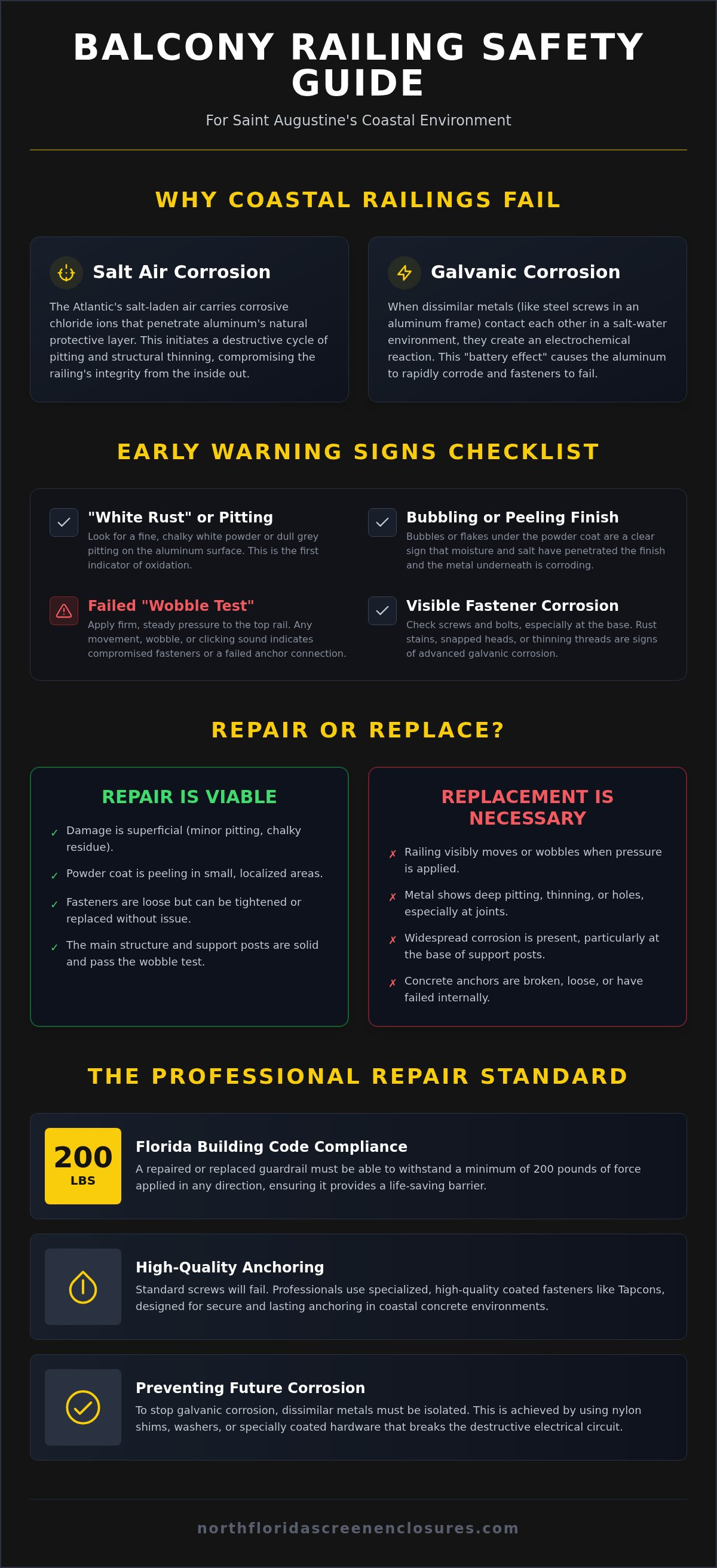
Living on the coast means your home is under constant chemical attack from the environment. While aluminum is inherently more resilient than steel or wood, it isn't invincible. Identifying early warning signs can be the difference between a simple maintenance task and a complex aluminum balcony railing repair Saint Augustine project. Often, the damage starts where you can't see it, hiding behind decorative trim or beneath the surface of the paint. Promptly addressing these issues is the only way to ensure the long-term safety of your elevated living spaces.
Visual Cues of Coastal Oxidation
The first sign of trouble is usually a fine, chalky residue known as "white rust." Unlike the orange flakes seen on iron, aluminum oxidation presents as a white powder or dull grey pitting. In Saint Augustine, salt crystals from the Atlantic breeze settle into the microscopic pores of the metal. These crystals trap moisture against the aluminum, leading to localized decay. Crevice corrosion is the primary threat to aluminum joints where moisture and salt become trapped in tight spaces. If you see bubbling under the powder coat, the metal underneath is already beginning to pit and lose its structural density.
The 'Wobble Test': Assessing Guardrail Integrity
A secure Guard rail is essential for life safety on any elevated surface. You can perform a basic integrity check by using the "wobble test." Stand near a support post and apply firm, steady pressure to the top rail. If you feel any movement or hear a clicking sound at the base, the connection is compromised. Movement usually indicates that the internal fasteners have thinned due to corrosion or that the concrete anchor has failed internally. If your balcony shows these signs, you might also want to check for similar issues by reading about expert pool enclosure repair in St. Augustine, as coastal enclosures face identical structural stresses.
Fastener failure is the most common cause of railing instability. Many builders use standard steel screws that react poorly with aluminum in a salt-air environment. This electrochemical reaction, known as galvanic corrosion, eats away at the screw threads until they can no longer hold a load. When the powder coat begins to peel or flake away in large chunks, it's often a sign that this corrosion has spread from the fasteners into the main structure of the railing. Ignoring these signs doesn't just hurt your home's curb appeal; it puts everyone who uses the balcony at risk. Structural integrity must always take precedence over aesthetics when dealing with elevated guardrails.
Why Coastal Railings Fail: The Impact of Saint Augustine’s Salt Air
The Atlantic breeze carries more than just a refreshing scent; it delivers a constant stream of corrosive chloride ions directly to your home's exterior. In Saint Augustine, these ions act as a chemical catalyst that aggressively attacks metal surfaces. While aluminum naturally forms a protective oxide layer, the high concentration of salt in our coastal air penetrates this barrier. Once the salt reaches the raw metal, it initiates a cycle of pitting and structural thinning that can compromise the safety of any elevated balcony.
Galvanic Corrosion in a Saltwater Environment
One of the most common reasons for failure is an electrochemical reaction known as galvanic corrosion. This occurs when two dissimilar metals, such as aluminum frames and stainless steel fasteners, come into contact in the presence of an electrolyte like salt water. This combination essentially creates a small battery, where the aluminum acts as a sacrificial anode and begins to dissolve. Standard hardware store screws often lack the necessary coatings to prevent this reaction, leading to snapped heads and loose posts within just a few seasons. Professional aluminum balcony railing repair Saint Augustine specialists prevent this by using coated fasteners or nylon shims to isolate the metals and break the electrical circuit.
The Saint Augustine Microclimate Factor
Your specific location in St. Johns County dictates your maintenance requirements. A beachfront property on A1A faces a much higher "salt load" than a home located several miles inland. However, properties near Matanzas Bay are also at high risk due to brackish spray and stagnant humidity. Salt loading is particularly dangerous because minerals accumulate on the undersides of railings where rain cannot naturally wash them away. This hidden buildup accelerates metal degradation while remaining out of sight for most homeowners.
North Florida’s intense heat and UV exposure further complicate the issue. The sun's rays eventually break down the chemical bonds in powder coatings, causing the finish to become brittle and develop microscopic cracks. These fissures allow salt and moisture to seep behind the paint, leading to the bubbling and peeling discussed in previous sections. Standards maintained by the International Code Council emphasize that railings must withstand specific weight loads to be considered safe. When UV damage and salt-air corrosion work together, the structural integrity required by these codes is quickly eroded. If you've noticed your railing's finish becoming dull or chalky, it's often the first sign that the protective barrier is failing and the underlying metal is at risk.
Aluminum Railing Repair vs. Full Replacement: Making the Right Call
Deciding whether to invest in a repair or commit to a full replacement is a common challenge for St. Johns County residents. The goal is always to maximize the lifespan of your existing system without compromising the safety of your family or guests. Choosing the right path for aluminum balcony railing repair Saint Augustine depends on several technical factors, starting with the thickness and density of the metal itself. If the core structure remains thick and resilient, targeted repairs can extend the life of your balcony by several years while saving you a significant amount compared to a total overhaul.
Professional contractors often use the "50% rule" as a financial guideline. If the cost of restoring your railing exceeds half the price of a new installation, a full replacement is usually the more economical choice in the long run. We also apply the "Rule of Three" as a baseline for safety. If more than three support posts in a single run show signs of structural compromise or base plate failure, the integrity of the entire system is likely in question. At that point, the labor required to safely rebuild the existing frame often outweighs the benefits of starting fresh.
When Repair is the Logical Choice
Repair is often the best route when the damage is localized rather than systemic. Loose pickets or rattling handrails can usually be re-secured or replaced individually without disturbing the main support frame. If you've noticed small patches of peeling powder coat but the metal underneath shows no signs of deep pitting, a professional refinishing can restore the barrier. For those considering how their current setup compares to modern options, you can reference our aluminum balcony railings guide for style and material comparisons. These minor interventions keep your home code-compliant and visually appealing without the need for heavy construction.
Signs that Replacement is Mandatory
There are specific scenarios where a repair is no longer a responsible option. Internal pitting is the most dangerous sign; it thins the metal walls from the inside out, making the railing brittle and prone to sudden failure under load. Widespread failure of the concrete mounting surface also necessitates a full replacement. If the balcony slab itself is crumbling or cracking around the post bases, the anchors will no longer hold, regardless of the railing's condition. Finally, if systemic corrosion has reached the internal support ribs of the posts, the system can no longer meet the load requirements set by local building codes. In these cases, a new installation is the only way to ensure lasting peace of mind.
Professional Repair Standards for Balcony Guardrails and Posts
Executing a proper aluminum balcony railing repair Saint Augustine requires more than just a toolkit; it demands a strict adherence to the Florida Building Code (FBC) and an understanding of coastal engineering. Unlike inland repairs where a simple bolt tightening might suffice, structural work in St. Johns County must account for the high wind loads and rapid metal degradation typical of our shoreline. Professional standards ensure that every component, from the handrail to the base plate, functions as a unified safety system capable of protecting your family and guests.
The Critical Role of Tapcon Replacement
The most frequent point of failure in coastal railings isn't the aluminum itself, but the anchors that secure the posts to the concrete slab. Original builders often use standard carbon steel anchors that lack the necessary corrosion resistance for our salt-heavy air. Over time, these anchors rust and expand, cracking the surrounding concrete and leaving the railing post loose. We prioritize the removal of these compromised fasteners and the installation of high-performance masonry anchors. In coastal St. Augustine, a railing is only as safe as the Tapcons holding it to the slab. Our process involves precision drilling and clearing of the existing holes to ensure the new anchors achieve maximum pull-out strength.
Ensuring Structural Compliance
Safety-critical repairs must meet the specific dimensions laid out by the FBC to remain legal and effective. For residential properties, guardrails must maintain a minimum height of 36 inches, though installations more than 30 inches above the ground often require a 42-inch height to maximize protection. Another vital standard is the "4-inch sphere rule," which dictates that the spacing between pickets or balusters must be narrow enough that a 4-inch ball cannot pass through. During a repair, we verify these measurements and reinforce top rails to ensure they can withstand a 200-pound concentrated load applied at any point along the rail.
Technical precision extends to the materials and methods used for joining components. While professional welding provides a seamless look, high-grade mechanical fastening is often preferred for field repairs because it allows the metal to expand and contract with North Florida's temperature swings without stressing the joints. Proper surface preparation is equally essential. We mechanically remove all "white rust" and oxidation before applying any new coatings. If you've noticed rust stains at the base of your posts or a slight rattle in your guardrail, it's time to secure your investment with professional Tapcon replacement and railing repair to ensure your home remains safe and compliant.
Restoring Safety with North Florida Screen Enclosures
North Florida Screen Enclosures operates with a deep understanding of the unique environmental pressures facing St. Johns County homeowners. We don't view a project as a simple fix; we see it as a restoration of your home's structural defense. Our team specializes in aluminum balcony railing repair Saint Augustine, ensuring that every weld, fastener, and post meets the rigorous demands of our coastal climate. By choosing a locally owned and operated contractor, you gain a partner who shares a vested interest in the safety and longevity of our community’s architecture.
The North Florida Screen Enclosures Difference
We prioritize materials that are engineered to survive where others fail. While many contractors use standard hardware, we insist on coastal-grade fasteners and high-performance Tapcon anchors to combat the galvanic corrosion discussed in previous sections. Our expertise extends beyond railings to include comprehensive exterior solutions like soffit and fascia work, providing a holistic approach to home maintenance. For those looking to secure their entire outdoor living space, you can also explore our custom pool enclosure installation services for total outdoor protection. We believe that durability is the ultimate form of value, and we stand by the integrity of our craftsmanship.
Schedule Your Railing Inspection
A professional assessment is the first step toward reclaiming your peace of mind. When you schedule a consultation with our team, you can expect a methodical evaluation of your railing’s current condition. We don't just look at the surface; we inspect the base plates, the concrete integrity, and the internal state of the fasteners. This thoroughness allows us to provide transparent, grounded estimates that reflect the actual needs of your structure rather than a one-size-fits-all solution. Our specialists are here to guide you through the decision-making process, whether you need a minor adjustment or a more significant structural reinforcement.
Don't wait for a minor wobble to become a major liability. Ensuring your balcony meets current safety standards is a critical responsibility for every homeowner. Contact North Florida Screen Enclosures for a railing safety check today and let our diligent craftsmen protect your investment for years to come. We're committed to providing the technical expertise and reliable service that Saint Augustine residents have come to expect.
Secure Your Coastal View for the Long Term
Maintaining a safe and attractive home in St. Johns County requires a proactive approach to the Atlantic's corrosive effects. By identifying early signs of oxidation and understanding the critical importance of building code compliance, you can prevent minor issues from becoming dangerous liabilities. Whether you're addressing a slight wobble in a support post or dealing with systemic fastener failure, choosing the right path for aluminum balcony railing repair Saint Augustine ensures your investment remains sound.
Our team at North Florida Screen Enclosures brings specialized expertise in hurricane-resistant aluminum construction to every project. As a locally owned Saint Augustine specialist, we prioritize structural integrity and use only the highest quality materials, including durable Tapcon replacement hardware designed for coastal resilience. We take pride in our diligent craftsmanship and the peace of mind we provide to our neighbors through reliable, technical solutions.
Schedule your professional aluminum railing inspection with North Florida Screen Enclosures to ensure your outdoor space is safe and ready for another season of coastal living. Your home deserves the protection of high-quality workmanship that stands the test of time.
Frequently Asked Questions
How much does it cost to repair an aluminum balcony railing in Saint Augustine?
The total cost for restoration depends on the extent of the structural damage and the number of fasteners requiring replacement. Minor hardware adjustments and picket re-securing are generally more affordable than systemic post-to-concrete restoration. We recommend a professional assessment to determine if your specific project falls under simple maintenance or requires a more complex aluminum balcony railing repair Saint Augustine. Factors like height accessibility and the condition of the concrete slab will also influence the final estimate.
Is it safe to paint over rusted aluminum railings?
Painting directly over aluminum oxidation, often called "white rust," is not a reliable long-term solution. The corrosion will continue to spread beneath the new layer, eventually causing the paint to bubble and peel again. Successful restoration requires mechanically removing the pitting and applying a coastal-grade primer designed for marine environments. If the oxidation has thinned the metal walls, the railing may require structural repair rather than a simple aesthetic touch-up to ensure safety.
Why is my aluminum railing wobbly even though the screws look fine?
Instability often stems from "hidden" corrosion occurring where the support post meets the concrete slab. While the visible screw heads might look intact, the internal threads or the masonry anchors beneath the surface could be thinned by salt air. This is a common sign that you need professional aluminum balcony railing repair Saint Augustine to inspect the anchor's pull-out strength. In many cases, the concrete around the anchor has developed internal micro-cracks that compromise the entire connection.
Can you replace just one section of a balcony railing?
Individual sections or pickets can typically be replaced if the main support posts remain structurally sound. This targeted approach is a cost-effective way to address localized damage from falling debris or specific impact points without disturbing the entire system. However, our technicians always inspect the adjacent sections during the process. If the failure in one area is due to systemic salt-air corrosion, it's likely that other sections will soon require similar attention to maintain safety standards.
How long do aluminum railings last in a coastal environment like Florida?
High-quality aluminum railings can last 20 years or more in Saint Augustine if they are maintained correctly. Without regular cleaning, the salt spray from the Atlantic can begin to pit the surface and compromise the finish within five to seven years. The lifespan of your system largely depends on the quality of the original powder coating and the type of fasteners used during installation. Using high-performance anchors like Tapcons significantly extends the structural life of the system.
What is the best way to clean salt off my aluminum railings to prevent repair?
Regular rinsing with fresh water is the most effective way to prevent salt accumulation and subsequent metal degradation. We recommend washing your railings with a mild, non-abrasive soap and a soft cloth at least once every three months. Pay close attention to the undersides of the handrails and the joints where salt crystals tend to hide. This simple maintenance routine prevents the electrochemical reactions that lead to expensive structural failures and helps maintain the powder-coated finish.
Does insurance cover balcony railing repair after a hurricane?
Coverage depends entirely on your specific homeowner's policy and the documented cause of the damage. Insurance typically covers sudden, accidental damage caused by wind or falling objects during a named storm. However, most policies exclude repairs for long-term corrosion or "wear and tear" caused by the coastal environment. It's important to document any storm damage immediately and consult with your insurance adjuster to see if your railing restoration qualifies under your specific hurricane coverage terms.
What are the building code requirements for balcony railings in St. Johns County?
St. Johns County follows the Florida Building Code, which mandates a minimum railing height of 36 inches for residential balconies. If the balcony is more than 30 inches above the ground, a 42-inch height is often required for safety. Additionally, the spacing between pickets must be narrow enough that a 4-inch sphere cannot pass through at any point. All guardrails must also be capable of withstanding a 200-pound concentrated load applied at any point along the top rail.
Comments