


Hurricane Rated Pool Enclosures: Engineering for Storm Resilience in 2026
- Michael Caruso

- Aug 4
- 12 min read
Would your current screen survive a 160 mph gust, or is it simply waiting for the next named storm to become a pile of twisted aluminum? For many Saint Augustine homeowners, the sound of rising wind brings a familiar sense of dread about the failure of hurricane rated pool enclosures and the exhausting cycle of expensive screen repairs. It is frustrating to face the confusion of shifting regulations, especially with the 9th Edition of the Florida Building Code set to take effect on December 31, 2026. You deserve a beautiful outdoor space that offers genuine security without the constant fear of structural failure.
We understand that true peace of mind comes from knowing your property meets the highest safety standards. This guide explains exactly what defines a storm-resilient structure and how the latest engineering advancements protect your investment. You will learn about the critical role of site-specific engineering and why the synergy of reinforced aluminum alloys and corrosion-proof fastening systems is vital for coastal resilience. We will also preview the 2026 design trends, including panoramic views that meet the new 160 mph wind-resistance thresholds without sacrificing your backyard aesthetics.
Table of Contents
What Defines a Hurricane Rated Pool Enclosure in North Florida?
In the coastal environment of Saint Augustine, a hurricane rated pool enclosure is more than just a screened-in patio. It is a precisely engineered aluminum structure designed to remain standing through extreme wind events. While many homeowners assume "hurricane rated" means the screen mesh will never tear, the reality is quite different. The rating applies to the structural integrity of the frame, the thickness of the aluminum beams, and the depth of the foundation anchoring. A truly rated system ensures that even if the mesh is destroyed, the skeletal structure remains intact and secured to your home.
When we discuss Hurricane-proof building techniques, we are really talking about the management of wind loads. For hurricane rated pool enclosures, this involves a synergy between high-grade aluminum alloys and site-specific engineering. The goal is to prevent the enclosure from becoming airborne debris, which protects both your property and your neighbors' homes. Every component, from the grade of the aluminum to the diameter of the fasteners, must meet or exceed the standards set by the Florida Building Code.
Understanding Wind Speed Ratings and Risk Zones
Saint Augustine falls into a high-velocity wind zone where requirements are significantly stricter than in inland Florida. Most modern permits in our area require structures to handle wind speeds between 130 and 150 MPH. However, with the 9th Edition of the Florida Building Code taking effect on December 31, 2026, many coastal structures within five miles of tidal waters will need to meet a 160 MPH threshold. Engineers also look at "Exposure" categories. Exposure B typically applies to urban or wooded areas where wind is obstructed, while Exposure C applies to open terrain and coastal properties where wind hits the structure with full force. We provide site-specific engineering for every project to ensure these exact variables are addressed.
The 'Blow-Out' Principle: Protecting the Aluminum Frame
It sounds counterintuitive, but your screen mesh is designed to fail. During a major storm, screen panels act like massive sails, catching the wind and transferring thousands of pounds of pressure to the aluminum beams. If the screen is too strong or the splines are too tight, the entire structure can be pulled out of the concrete. The "blow-out" principle allows the screen panels to pop out of their tracks or tear once a certain wind pressure is reached. This self-sacrificing mechanism relieves the pressure on the frame, saving the expensive aluminum skeleton from collapsing. Using rigid, non-flexible screening that refuses to give way can actually cause a catastrophic structural failure during a hurricane.
The Anatomy of a Storm-Resistant Screen Structure
The skeleton of a high-performance enclosure relies on specialized materials that go far beyond standard residential aluminum. We utilize 6005-T5 aluminum alloy, a tempered material known for its superior tensile strength and resistance to bending under extreme pressure. While standard alloys might suffice for simple decorative frames, hurricane rated pool enclosures in Saint Augustine require this industrial-grade metal to withstand the sheer force of coastal gusts. This alloy ensures the frame remains rigid, providing a stable foundation for the various bracing systems that prevent the structure from swaying or collapsing sideways.
Lateral stability is achieved through a combination of corner bracing and K-bracing. These diagonal supports create a series of triangles within the frame, which is the strongest geometric shape for load distribution. Without these reinforcements, a pool cage is susceptible to racking, a term used when a rectangular frame leans and eventually folds under pressure. By incorporating these elements, we align our construction with broader FEMA guidelines for storm resilience, ensuring that every joint and beam contributes to the overall stability of the home environment.
Gusset Plates and Structural Reinforcements
A gusset plate is a thick aluminum bracket that reinforces the connection between beams and uprights. Its primary role is to distribute stress across a larger surface area, preventing the bolts from shearing through the aluminum during a storm. As we move toward the 2026 building standards, the thickness of these plates has increased to provide even greater resistance to structural racking. In high-stress areas, we also utilize internal sleeve reinforcements. These are secondary aluminum tubes inserted inside the main uprights to double the wall thickness where the wind load is most intense. If you are concerned about the current state of your frame, our team can evaluate your structure during screen enclosure repairs to identify potential weak points.
Elite Roofing Systems and Solid Cover Integrity
While traditional screen roofs allow for maximum airflow, many homeowners are opting for Elite roofing systems to enhance storm resilience. These solid, insulated panels offer significantly better uplift resistance compared to standard aluminum pans or screen mesh. The interlocking design of an Elite roof creates a unified surface that is much harder for the wind to get under and peel away. These systems allow for the seamless integration of soffit and fascia, creating a tight seal that prevents wind from entering the roof cavity. This combination of structural strength and thermal insulation makes it a premier choice for hurricane rated pool enclosures that offer the ultimate in backyard protection.
Why Fasteners and Tapcons are the Weakest Link
A massive aluminum frame engineered for 150 MPH winds is ultimately held in place by a series of small, specialized screws at the base. These are Tapcons. They serve as the critical link between your pool cage and the concrete deck. For hurricane rated pool enclosures, the integrity of these anchors is just as important as the thickness of the aluminum beams themselves. If the fasteners fail, the entire structure can pivot, slide, or lift, regardless of how robust the frame appears. This is why anchoring systems must strictly adhere to the Florida Building Code wind load standards, which dictate the precise spacing and depth of every fastener used in coastal construction.
In the unique environment of Saint Augustine, the proximity to the Atlantic Ocean introduces a silent enemy: salt air. When steel fasteners are driven into aluminum frames, a chemical reaction known as galvanic corrosion occurs. This process is significantly accelerated by the high humidity and salt spray found in North Florida. Over time, this interaction eats away at the metal, turning a structural anchor into a brittle liability. Even a perfectly designed enclosure is only as reliable as the screws holding it to the earth.
The Danger of Rusted Tapcons
Standard carbon steel screws are often the first point of failure in our local climate. Homeowners should look for the "bleeding" effect, which appears as orange or brown rust stains running down the concrete deck from the base of the aluminum. This is a clear warning sign of structural compromise. By the time rust is visible on the head of a screw, the shank embedded in the concrete has likely thinned or become brittle. Data from structural inspections indicates that rusted fasteners can lose up to 90% of their holding power before they actually break. During a major storm, this hidden weakness allows wind pressure to pull the base plate right off the deck, leading to catastrophic failure.
Professional Tapcon Replacement and Upgrades
Maintaining the resilience of hurricane rated pool enclosures requires proactive fastener management. For coastal homes, we recommend upgrading to 304 or 316-grade stainless steel fasteners. These materials offer the highest level of resistance to the corrosive salt spray prevalent in our region. Our professional Tapcon replacement process involves the following steps:
Individual extraction of compromised or rusted screws to maintain cage tension.
Precision drilling to ensure the new stainless steel anchors seat properly in the existing concrete.
Application of Nylotec or Pro-Tect caps to provide an extra layer of moisture protection.
These specialized caps seal the fastener head from the elements, preventing standing water from initiating the corrosion cycle. This methodical approach allows us to restore the structural integrity of your enclosure without the need for a full teardown. Regular maintenance of these small components is the most practical way to ensure your backyard remains a safe haven during hurricane season.
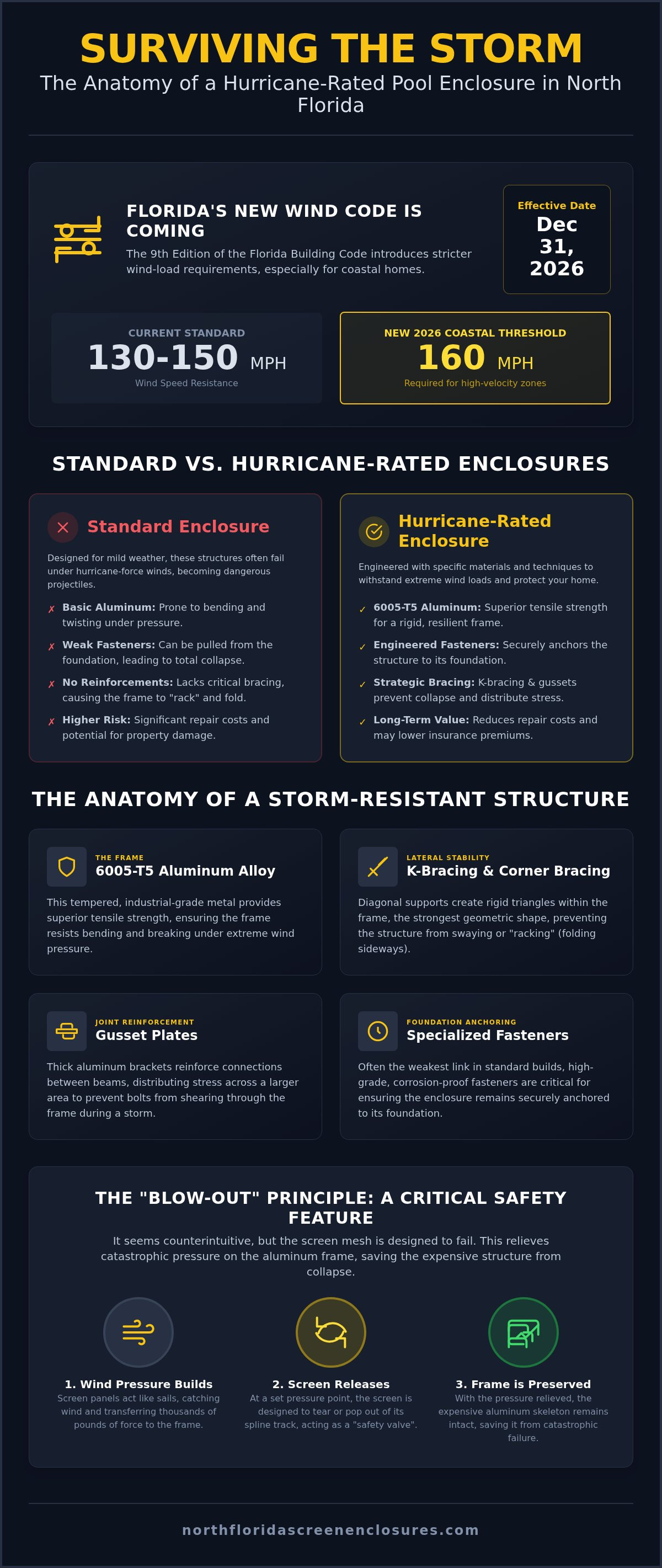
Comparing Standard vs. Hurricane Rated Enclosures
Choosing between a standard screen room and a high-wind engineered structure often comes down to a balance of immediate budget and long-term resilience. While both designs effectively keep out pests and debris, their performance during a North Florida summer squall or a major hurricane differs significantly. Standard enclosures are typically constructed using 2x3 or 2x4 aluminum beams. These smaller profiles are sufficient for basic structural support but lack the rigidity required to resist the intense pressure of 140 MPH winds. In contrast, hurricane rated pool enclosures utilize 2x5, 2x6, or even larger beam profiles to ensure the frame remains stable when the wind load peaks.
The difference also extends to the technology used to hold the mesh in place. Standard cages use basic spline, which can sometimes allow screens to pop out during relatively minor gusts. High-wind systems utilize advanced spline locking techniques designed to maintain tension longer. This ensures the enclosure remains functional through tropical-storm-force winds while still allowing for the "blow-out" safety mechanism during extreme events. Despite the heavier materials, modern engineering allows these structures to maintain a refined look. You don't have to sacrifice your view for safety. Many homeowners now opt for "clearview" designs that use reinforced horizontal beams to provide panoramic vistas without the clutter of excessive vertical supports.
Cost-Benefit Analysis for Saint Augustine Homeowners
Investing in a hurricane-rated system provides financial advantages that extend beyond storm season. Many insurance providers in Florida offer premium credits for homes with structures engineered to current building codes. Furthermore, these robust systems drastically reduce the frequency of "nuisance repairs." After a typical summer storm, owners of standard cages often deal with torn mesh or loose fasteners. A rated structure minimizes these minor headaches, saving you time and repetitive maintenance costs. In the competitive Saint Augustine real estate market, a certified storm-resistant enclosure also serves as a significant selling point, increasing the overall resale value and appeal of your property.
Upgrading an Existing Enclosure
A common question we encounter is whether a standard cage can be retrofitted to become fully hurricane rated. While you can certainly strengthen an older structure, achieving a true "rated" status usually requires the specific beam sizes and foundation anchors found in new builds. However, significant improvements are possible. A complete re-screen using high-tensile mesh and stainless steel Tapcon upgrades can breathe new life into an aging frame. We focus on identifying the specific weak points of your current setup to determine if a targeted reinforcement or a full replacement is the most practical path forward for your home's protection.
Building for the Coast with North Florida Screen Enclosures
North Florida Screen Enclosures is more than just a contractor; we are your neighbors in Saint Augustine. We understand that our local environment demands more than just a standard build. Our team approaches every project with a focus on structural longevity and aesthetic harmony. We don't just install a cage. We manage the entire transformation of your outdoor space. This includes everything from the initial concrete work and paver patios to the final precision-engineered enclosure. By handling every phase of the hardscaping and construction, we ensure that the foundation is as resilient as the aluminum frame it supports.
Our custom design process is built around your specific backyard vision. We balance your desire for an unobstructed view with the rigorous demands of the Florida Building Code. This methodical approach ensures that your space is both beautiful and compliant with the latest safety standards. We take pride in our identity as a diligent craftsman, focusing on the fine details that other companies might overlook. This commitment to quality is why we remain a trusted local expert for hurricane rated pool enclosures across the region.
The North Florida Design and Installation Process
Every project begins with a comprehensive structural assessment of your property. We handle the complexities of local permitting, ensuring that your new structure meets the specific wind-load requirements of your neighborhood. Selecting materials for Saint Augustine’s salt-heavy air is a critical step in our process. We prioritize corrosion-resistant components and high-grade alloys that can withstand the coastal climate for decades. Our professional installation crews are trained specifically for high-wind environments. They understand the nuances of lateral stability and fastener depth, ensuring that your enclosure is built to the highest possible standard.
Long-Term Protection and Maintenance Services
True storm resilience requires ongoing attention. We recommend scheduling a structural integrity check well before the 2026 hurricane season begins. Our team evaluates your existing structure for signs of fastener fatigue or frame misalignment. Beyond new construction, we offer a suite of specialized services to keep your property in peak condition. This includes aluminum fascia repair, balcony railings, and complete re-screening to restore the tension of your cage. These proactive steps are the most effective way to protect your investment and ensure your home is ready for whatever the Atlantic brings.
Secure Your Backyard for the Seasons Ahead
Building for the coast requires a disciplined approach to engineering and a deep understanding of Saint Augustine’s unique climate. True resilience is found in the synergy of 6005-T5 aluminum alloys and high-grade stainless steel fasteners. Ensuring your home meets the 2026 Florida Building Code standards isn't just about regulatory compliance. It's about protecting your long-term investment and gaining peace of mind. Professional maintenance, such as specialized Tapcon replacement, remains the most effective way to prevent structural failure during a high-wind event.
North Florida Screen Enclosures is a locally owned and operated specialist dedicated to high-quality workmanship. We provide custom-engineered solutions for Florida’s high-wind zones, ensuring hurricane rated pool enclosures are built to last. Whether you need a complete new installation or a structural integrity check for an existing cage, our team is ready to help. Request a Free Hurricane Readiness Quote Today and take the first step toward a more secure outdoor living space. Your home is a valuable asset. We are here to help you defend it with confidence.
Frequently Asked Questions
What wind speed is a standard pool enclosure rated for in Florida?
Standard pool enclosures in Florida are typically designed to withstand wind speeds between 130 and 140 MPH, depending on your specific location. However, homeowners in Saint Augustine often face stricter requirements due to their proximity to the coast. Under the 2026 building code updates, structures within five miles of tidal waters must meet a 160 MPH resistance threshold. It's vital to verify your property's specific exposure category to ensure your structure meets the legal safety standards for your neighborhood.
Will a hurricane-rated pool enclosure lower my insurance?
Many Florida insurance providers offer premium credits or discounts for structures that meet or exceed current wind-load engineering standards. By installing hurricane rated pool enclosures, you demonstrate a proactive approach to risk mitigation that protects the main home from flying debris. You should provide your insurance agent with the final permit and engineered drawings. These documents serve as proof that your outdoor space is built to survive extreme weather, which can lead to long-term savings on your homeowners' policy.
How often should I replace the Tapcons on my pool cage?
You should generally inspect your fasteners every three to five years, but full replacement is often necessary every five to seven years in coastal environments. Salt air accelerates the corrosion of standard steel screws, leading to brittle anchors that can snap under pressure. If you see orange rust stains "bleeding" onto your concrete deck, it's a sign that the structural integrity is compromised. Upgrading to 304 or 316 stainless steel fasteners during maintenance will provide much better resistance to the Saint Augustine climate.
Do I need a permit to build a hurricane-rated enclosure in Saint Augustine?
Yes, a building permit is mandatory for any new pool enclosure or significant structural repair in Saint Augustine. The local building department requires stamped engineered drawings from a licensed Professional Engineer to ensure the design accounts for specific wind-load zones. We handle the entire permitting and documentation process for our clients. This ensures that your project is fully compliant with St. Johns County regulations and the 9th Edition of the Florida Building Code.
Can a panoramic pool enclosure be hurricane rated?
Panoramic or "clearview" designs can absolutely be hurricane rated when they are engineered with reinforced horizontal beams and heavier aluminum profiles. These structures eliminate many vertical supports to provide an unobstructed view of the landscape without sacrificing stability. The engineering simply redistributes the wind load to more robust structural members at the corners and roofline. This allows you to enjoy a modern, open aesthetic while still meeting the 160 MPH wind-resistance thresholds required for coastal safety.
What is the best screen material for hurricane-prone areas?
High-tensile polyester mesh is widely considered the best option for hurricane-prone areas because it's much harder to tear than standard fiberglass. While the "blow-out" principle is necessary to save the aluminum frame during extreme gusts, these durable materials survive typical tropical storms without needing replacement. This longevity helps maintain the necessary tension for hurricane rated pool enclosures over many years. Using a high-quality mesh reduces the frequency of nuisance repairs and keeps your pool area debris-free after minor weather events.
What happens if my pool enclosure is damaged during a storm?
If a storm causes damage, your first step is to determine if the aluminum frame has shifted or if only the screen mesh has torn. Torn screens are often a designed safety feature that relieves wind pressure to save the skeleton of the structure. However, a leaning frame or loose base plates indicate a serious structural failure. You should contact a specialist to perform a structural integrity check; they can identify if you need targeted repairs or a complete fastener replacement to restore safety.
How much more does a hurricane-rated enclosure cost compared to a standard one?
A hurricane-rated system requires a higher initial investment because it utilizes thicker 6005-T5 aluminum, larger beam profiles, and stainless steel fasteners. While the upfront cost for materials and site-specific engineering is greater, the long-term value is significant. You'll likely save money over time by avoiding repetitive screen repairs and lowering your insurance premiums. Most importantly, a rated structure provides the peace of mind that your backyard won't require a total rebuild after the next major storm hits the coast.


Comments