


Paver Patio Replacement in St. Augustine: Repair vs. Replace Guide

The quickest fix for a shifting patio often guarantees you will rebuild the entire surface twice. When you notice tripping hazards around your pool deck or washed-out joints after a heavy summer downpour, sweeping in fresh sand feels like a practical solution. In our coastal environment, however, surface treatments cannot remedy underlying drainage failure. If you are weighing a minor repair against a complete paver patio replacement St. Augustine soil conditions and storm patterns often make that decision for you beneath the surface.
You shouldn't have to battle persistent weeds, sunken pavers, or standing water pooling against your foundation after every seasonal storm. In this guide, you will learn how to distinguish cosmetic surface wear from deep base failure and evaluate whether a DIY repair or a professional installation makes practical sense for your home. We examine the exact structural standards required to create a level, resilient outdoor space engineered to endure North Florida's coastal climate for decades to come.
Table of Contents
Evaluating Your Patio: When to Repair vs. When to Replace
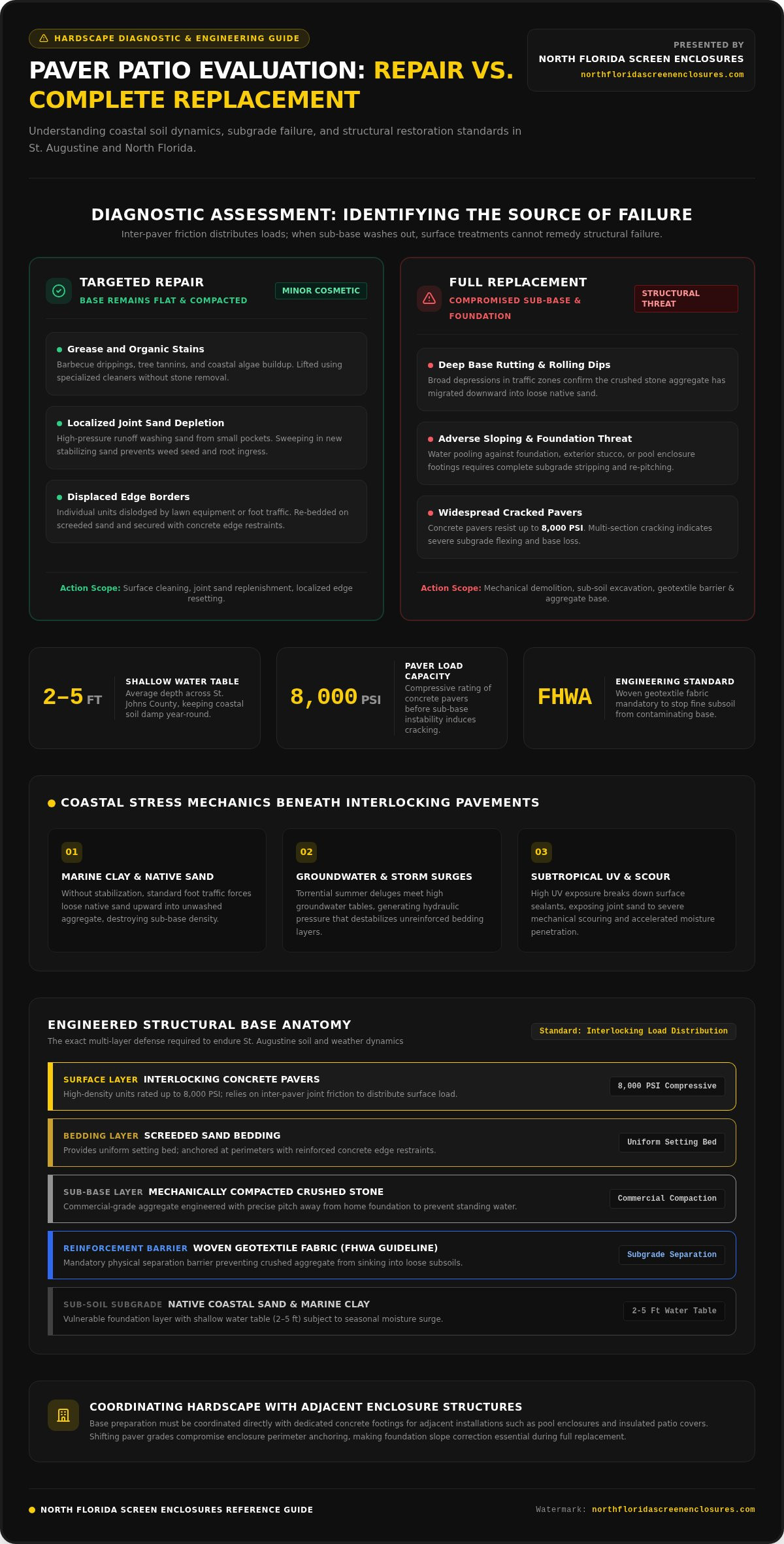
Homeowners often hear that simple pressure washing and fresh polymeric sand can fix any hardscape issue. While surface treatments refresh aesthetics, they fail when sub-surface erosion compromises the ground underneath. A traditional paving stone system relies entirely on inter-paver friction to distribute heavy loads evenly. When the underlying aggregate washes away, individual stones take the full brunt of foot traffic and structural weight, leading to severe settling and dangerous trip hazards. Knowing whether your outdoor living area requires basic maintenance or a comprehensive paver patio replacement St. Augustine soil often demands starts with identifying where the failure truly originates.
Minor Surface Issues Solved by Targeted Repair
Cosmetic blemishes and localized shifting rarely require a complete teardown. You can typically restore the deck through straightforward targeted repairs if the base layer remains compacted and flat:
Grease and Organic Stains: Barbecue drippings, tree tannins, and coastal algae buildup can be lifted using specialized cleaners without lifting the stones.
Localized Joint Sand Depletion: High-pressure runoff can wash sand out of small areas; sweeping in new stabilizing sand prevents weed seeds and root systems from taking hold.
Displaced Edge Borders: Individual border units dislodged by lawn equipment or foot traffic can be lifted, re-bedded on a screeded sand bed, and secured with fresh concrete edge restraints.
Critical Warning Signs Demanding Complete Replacement
When the sub-base beneath the patio shifts or washes out, surface repairs only delay inevitable structural failure. Complete replacement becomes necessary when structural integrity is lost:
Deep Base Rutting: Broad depressions or rolling dips across high-traffic zones indicate the crushed stone sub-base has migrated into the native sand below.
Adverse Sloping and Foundation Threats: Stormwater must drain away from your home. If settling causes rainwater to pool against your foundation, exterior stucco, or pool enclosure footings, the patio grade must be completely stripped and re-engineered.
Widespread Cracked Pavers: Concrete pavers can withstand up to 8,000 PSI under normal conditions. If pavers crack across multiple sections, an unstable, shifting base is flexing beneath them.
Attempting to patch wide structural hollows with extra sand merely hides the issue until the next tropical storm. In these scenarios, a full paver patio replacement St. Augustine homeowners invest in provides the only lasting fix by correcting deep sub-base compaction, installing stabilizing geotextiles, and restoring proper pitch away from your home.
Why St. Augustine Soil and Weather Cause Paver Patio Failure
St. Augustine presents distinct geological challenges that standard hardscape practices often fail to accommodate. A shallow water table, resting just two to five feet below grade across much of St. Johns County, keeps coastal soil damp year-round. When tropical storms hit, sudden surges of groundwater combine with torrential surface deluges to destabilize the ground beneath your feet. Sandy coastal soils mixed with marine clay shift rapidly under these conditions, washing out unreinforced bedding layers. At the same time, intense subtropical UV exposure degrades standard surface sealants, leaving paver joints vulnerable to scour and moisture penetration. When this continuous erosion hollows out the sub-grade, an engineered paver patio replacement St. Augustine specialists recommend becomes the only durable answer.
The Impact of Native Sand and High Water Tables
Without an engineered separation barrier, loose native sand inevitably migrates upward into the aggregate base under standard foot traffic. Water table fluctuations speed up this cross-contamination, causing unwashed limestone or weak gravel bases to settle unevenly. In line with Federal Highway Administration guidelines for interlocking pavements, maintaining structural subgrade integrity requires separating fine subsoils from compacted crushed stone with woven geotextile fabric. Skipping this reinforcement guarantees base migration and eventual sinkage in our high-moisture environment.
Stormwater Runoff and Coastal Weather Dynamics
Afternoon summer thunderstorms dump substantial volumes of water in short intervals, creating intense mechanical pressure along perimeter edges. If your roof channels heavy sheets of rainwater directly onto the patio surface, the cascading volume easily strips joint sand and hollows out edge restraints. You can safeguard your investment by pairing your hardscape with an elite roofing system to route water safely away from vulnerable foundation perimeters. If recurring storms have compromised your outdoor living area, consulting with North Florida Screen Enclosures ensures your next paver patio replacement St. Augustine installation is properly graded to shed water away from your home.
DIY Patio Paver Repair vs. Professional Replacement: Comparing Value
Homeowners facing uneven decks often wonder if a weekend spent with a shovel and hand tamper can resolve the problem. While resetting a few border stones is an achievable afternoon task, reconstructing an entire failing foundation by hand presents severe physical and mechanical hurdles. A typical 300-square-foot outdoor living space requires moving tons of dense material, including excavating unstable subsoil and transporting compacted aggregate. Without commercial equipment, matching the structural stability of an engineered professional paver replacement process remains nearly impossible in North Florida's shifting coastal ground.
The Realities and Limitations of DIY Repairs
Manual repairs demand backbreaking effort that often yields short-lived results. Homeowners attempting to relevel deep depressions run into distinct mechanical barriers:
Inadequate Compaction Force: Hand tamps and lightweight rental plate compactors rarely deliver the centrifugal force required to lock 6 to 8 inches of crushed aggregate into native sand.
Recurring Washout Cycles: Shoveling extra bedding sand under sunken stones treats the symptom without addressing the lost sub-base, leading to repeated settling during the next heavy downpour.
Exhausting Material Handling: Pulling up hundreds of interlocked stones, scraping degraded bedding material, and screeding new layers manually quickly consumes dozens of hours of intense physical labor.
Long-Term Protection of Professional Hardscaping
Contractors bring specialized heavy machinery and precision measurement tools that guarantee stability across high-traffic zones. Heavy reversible plate compactors consolidate aggregate in uniform lifts, creating a rigid platform that prevents individual stones from sinking. Professional crews also utilize optical transit levels to establish precise outward slopes, protecting exterior walls by shedding stormwater efficiently toward designated lawn swales.
Integrating your hardscape into a cohesive layout also allows you to implement proven Florida paver patio design concepts. Whether incorporating modern large-format slabs or classic herringbone layouts, seasoned contractors ensure proper edge restraint anchoring and geotextile installation. Investing in a professional paver patio replacement St. Augustine builders engineer protects your outdoor space from chronic ground shifting, delivering true long-term value over temporary weekend fixes.
The Step-by-Step Professional Paver Replacement Process
Executing an enduring paver installation in coastal Northeast Florida demands methodical groundwork rather than quick surface cosmetic fixes. Because St. Augustine properties face distinct challenges with uncompacted sandy subsoils and seasonal downpours, rebuilding a failed outdoor floor requires deep excavation and structural reinforcement. When done correctly, this systematic reconstruction restores foundational pitch, safeguards adjacent screen enclosures, and prevents ground migration beneath your outdoor living footprint.
Site Demolition and Engineered Foundation Preparation
Precision begins by dismantling the failed hardscape while protecting surrounding features. Experienced crews work methodically through structural site prep:
Surgical Removal: Excavation teams pull up old stones and salvage intact units where applicable, protecting underground utility feeds, irrigation loops, and nearby aluminum enclosure footings.
Excavating Unstable Subsoil: Degraded bedding sand and shifting native soil are removed down to solid, undisturbed ground levels to eliminate organic rot pockets.
Woven Geotextile Installation: A continuous commercial-grade stabilization geotextile is rolled out across the raw subgrade, acting as an impermeable barrier against sand-base intermixing.
Tiered Aggregate Base Compaction: Crushed concrete or crushed limestone road base is spread in measured lifts, running heavy mechanical compactors over each tier to reach maximum load-bearing density.
Laser Pitch Calibration: Installers verify a continuous quarter-inch-per-foot outward slope using optical transits, ensuring heavy stormwater drains away from your foundation walls.
Laying, Edging, and Final Joint Stabilization
Once the base platform is stabilized, the surface structure is assembled. A clean layer of washed bedding sand is screeded across the crushed stone to create an even, uncompacted setting cushion. Pavers are positioned tightly in interlocked geometries, such as durable herringbone patterns, which distribute downward loads across multiple contact points. Heavy-duty commercial edge restraints are immediately driven deep into the aggregate perimeter with long steel spikes to halt lateral creeping.
The final stage locks the paving stones into an integrated surface system. Advanced polymeric joint sand is swept across dry stones, vibrated down into joints using plate tampers fitted with protective mats, and activated with a controlled water mist. This initiates a polymer bond that resists high-wind washouts and weed colonization. If your backyard features settling issues or chronic ponding, schedule a site evaluation with North Florida Screen Enclosures to plan an engineered paver patio replacement St. Augustine homeowners count on for lasting resilience.
Integrating Paver Patios with Enclosures and Outdoor Structures
Most hardscape contractors view a patio as an isolated horizontal surface. In St. Johns County, however, ground-level paving stones routinely interface with heavy overhead structures, from insulated patio covers to pool cages. When an outdoor living area settles or shifts unevenly, that ground movement exerts direct torsional stress on the aluminum framework bolted above it. A properly executed paver patio replacement St. Augustine homeowners commission must account for structural load paths, anchoring engineering, and moisture barriers where stone perimeters meet aluminum framework.
Footing and Anchoring Requirements for Screen Enclosures
Aluminum structures cannot rely on interlocking pavers alone for wind resistance. High winds generate tremendous uplift forces that easily dislodge individual stones. A durable installation isolates structural loads from decorative paving:
Poured Concrete Footings: Upright structural posts and cage base channels must anchor directly into poured concrete footers buried below the paver surface, never into the pavers themselves.
Coordinated Framing: Coordinating your project with a custom pool enclosure installation ensures structural anchors integrate seamlessly with the finished paver layout.
Corrosion Prevention: Trapped moisture between stone pavers and aluminum channels accelerates fastener degradation; installing dedicated drainage paths protects Tapcon anchor fasteners from coastal rust.
Choosing Your St. Augustine Hardscape and Enclosure Partner
Hiring separate crews for screening, roofing, and paver work often results in finger-pointing when drainage or structural anchoring issues occur. When a screen contractor blames the hardscaper for pooling water, and the hardscaper blames the screen crew for cracking border stones, the property owner bears the cost. Partnering with a specialized contractor possessing integrated expertise across patio covers, screen enclosures, and hardscaping avoids these costly conflicts.
Ensure your chosen builder understands local St. Johns County building permit thresholds, clearance sheet procedures, and impervious surface limits before breaking ground. A unified contractor manages every element, from sub-base compaction and footer pours to aluminum anchoring and overhead cover installation. Investing in a coordinated paver patio replacement St. Augustine craftsmen build from foundation to roof guarantees that your screens, rooflines, and hardscape components function together as a unified, storm-resilient living space.
Restore Lasting Stability to Your Outdoor Living Area
Surface fixes offer temporary relief, but addressing persistent dips, standing water, and dislodged sand requires treating the root cause beneath the stones. In coastal Northeast Florida, an enduring hardscape demands thorough sub-base stabilization, commercial geotextile separation, and deliberate drainage grading. When shifting ground threatens structural footers or pool cage anchors, investing in an engineered paver patio replacement St. Augustine homeowners trust safeguards both your backyard safety and property value against relentless coastal weather.
As a locally owned contractor based in Saint Augustine, North Florida Screen Enclosures provides seamless craftsmanship across custom paver patios, pool enclosures, and elite roofing systems. We engineer integrated outdoor environments built to withstand heavy tropical downpours, high water tables, and intense sun. Don't let base erosion undermine your outdoor investment. Request your outdoor living consultation with North Florida Screen Enclosures today and build a level, resilient sanctuary crafted to stand the test of time.
Frequently Asked Questions
How do I know if my St. Augustine paver patio needs replacement or just re-sanding?
You need a replacement when structural base movement creates widespread dips or channels water toward your house, whereas re-sanding only resolves minor, localized joint loss on a flat surface. If stones rock underfoot, crack under standard foot traffic, or show deep hollows across high-traffic zones, the underlying crushed rock has failed. In those situations, sweeping in sand merely delays inevitable settling.
Why do patio pavers sink and become uneven so quickly in North Florida?
Pavers sink quickly in North Florida because loose native sand and shallow coastal water tables allow bedding materials to shift rapidly. Without a durable geotextile separation barrier, fine subgrade sand mixes into the crushed aggregate base above it. When heavy summer downpours saturate the ground, uncompacted sub-base layers wash out into subterranean voids, causing stones to settle and create severe tripping hazards.
Can I replace damaged patio pavers myself, or should I hire a professional contractor?
You can handle isolated surface fixes yourself, but undertaking a complete paver patio replacement St. Augustine soil requires calls for professional equipment. Hand tools cannot generate the centrifugal compaction force needed to stabilize deep aggregate layers against coastal water tables. Contractors also use optical transit levels to guarantee proper slope, ensuring water drains away from your home rather than pooling against your slab.
How long does a professional paver patio replacement take to complete in Saint Augustine?
A standard professional paver patio replacement in Saint Augustine typically takes about three to five days of active site work, depending on project scale and weather. Excavating unstable soil and hauling away old materials usually consumes the first day. The remaining time focuses on rolling out geotextile fabric, compacting base aggregate in measured lifts, screeding sand, cutting perimeter stones, and locking joints with polymeric sand.
Can you build a screen enclosure or patio cover directly on top of new pavers?
No, you should never anchor structural posts for screen enclosures or patio covers directly into individual pavers. Florida wind codes require vertical support posts to mount into solid concrete footers poured beneath or flush with the hardscape. Skilled contractors coordinate footer placement before laying pavers, ensuring high-strength Tapcon anchors tie into reinforced concrete without cracking adjacent stones or trapping pooling water.
What type of base material is best for paver patios installed in sandy coastal soil?
The best base material for coastal St. Augustine installations is dense-graded crushed concrete or crushed limestone aggregate installed over woven geotextile fabric. Unlike round pea gravel or loose dirt, crushed aggregate features sharp, angular edges that interlock tightly when compacted with commercial machinery. When installed six to eight inches deep, this stone foundation resists groundwater saturation and prevents shifting under heavy structural loads.
How do heavy tropical storms affect newly replaced paver patios in St. Johns County?
Heavy tropical storms test edge restraints, pitch grading, and joint stabilization across newly replaced surfaces. When an engineered paver patio replacement St. Augustine crews construct features properly activated polymeric sand, joint washouts and weed intrusions are prevented even during severe deluges. Proper outward grading directs high-volume perimeter runoff into surrounding yard drainage swales, protecting your home foundation and screen enclosure footings from standing water damage.
Comments