


Aluminum Balcony Guardrails: 2026 Safety & Design Guide

In the salt-heavy air of Saint Augustine, a balcony railing is either a permanent safety asset or a ticking clock of corrosion. Most homeowners in North Florida know the frustration of watching ironwork flake away or wood balusters soften after just a few seasons of intense humidity. Installing high-quality aluminum balcony guardrails is the most effective way to eliminate these safety concerns while adhering to the latest 2026 building codes for residential and multi-family structures.
You likely want a solution that protects your guests and your property value without demanding a weekend of sanding and painting every single spring. We understand the need for structural integrity that doesn't compromise the aesthetic of your outdoor living space. This guide explains why aluminum is the superior choice for coastal safety and how to select a system that withstands our region's specific environmental demands.
We'll walk you through the essential 200-pound load resistance requirements, the 4-inch sphere safety rule, and the wind-speed ratings necessary for our hurricane-prone coastline. You'll also discover how modern powder-coated finishes and glass-integrated systems provide the "set it and forget it" durability that Florida's climate demands, giving you total peace of mind and enhanced curb appeal for years to come.
Table of Contents
What are Aluminum Balcony Guardrails?
A Guard rail serves as a critical safety barrier installed along the edge of elevated surfaces like balconies, porches, or stairs. Its primary function is to prevent falls by creating a secure perimeter that can withstand significant physical force. While many homeowners view them through the lens of curb appeal, aluminum balcony guardrails are engineered life-safety systems. They must meet rigorous building codes that dictate height, spacing, and load-bearing capacity.
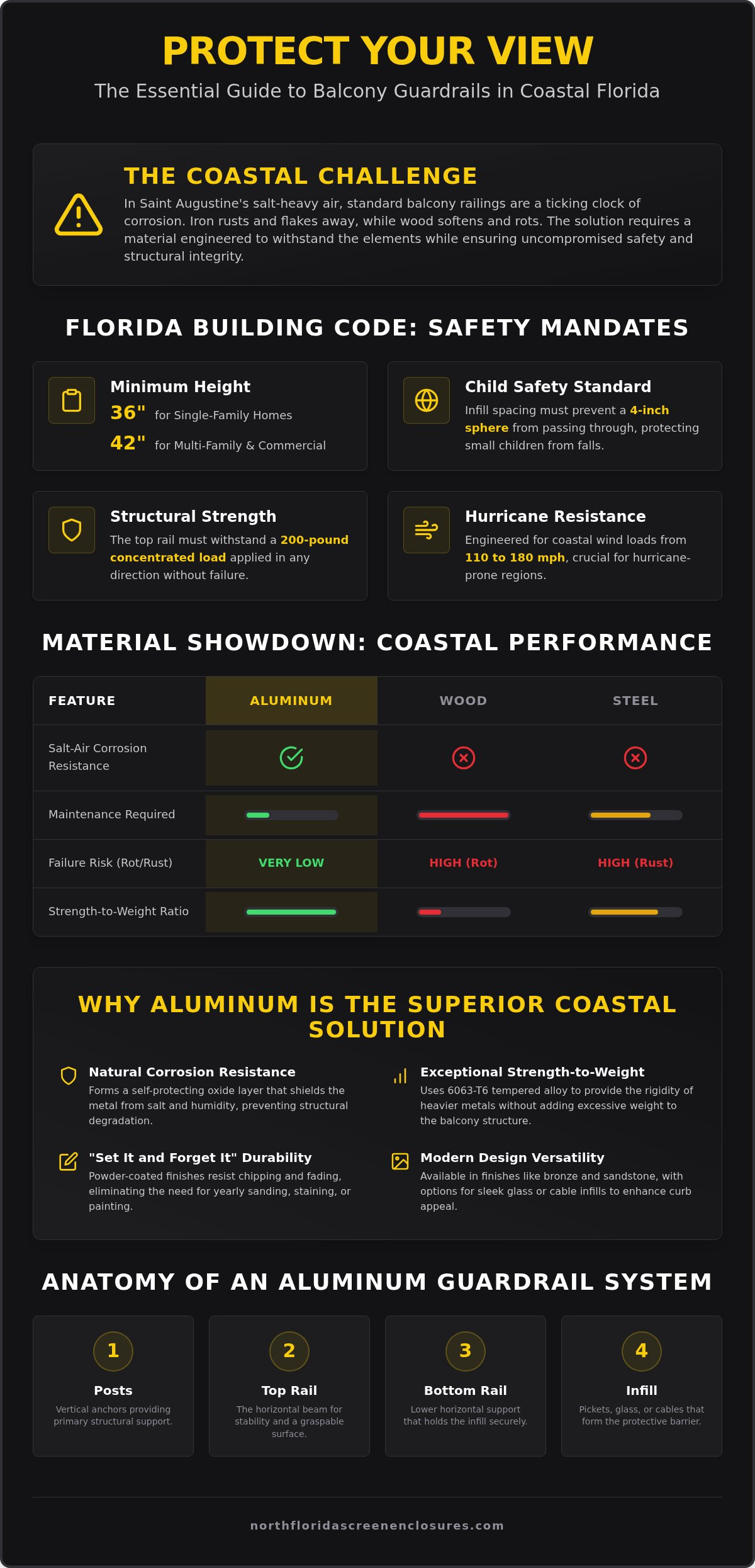
In North Florida's high-humidity environment, the choice of material isn't just a matter of taste; it's a matter of structural survival. Unlike wood that swells and rots or steel that flakes and rusts in the salt air of Saint Augustine, aluminum is naturally resilient. The material forms its own microscopic oxide layer that protects the core metal from the elements. A standard system consists of four primary components:
Posts: The vertical structural members that anchor the system to the balcony floor.
Top Rails: The horizontal beam that provides lateral stability and a surface for leaning.
Bottom Rails: The lower horizontal support that holds the infill in place.
Infill: The material between the posts, such as vertical pickets, glass panels, or cable systems, designed to prevent passage through the barrier.
Guardrail vs. Handrail: Understanding the Difference
It's common to use these terms interchangeably, but they serve distinct roles in residential safety. A guardrail is a barrier meant to keep people from falling off an edge. It's typically required to be 36 to 42 inches high depending on the building type. A handrail, by contrast, is a graspable support rail intended to guide someone safely up or down stairs. It must be between 34 and 38 inches high. Modern aluminum systems are highly versatile; they can be designed to integrate both components into a single, seamless assembly that meets all local codes without looking cluttered.
The Role of Structural Integrity in Elevated Spaces
Installing a barrier on a second-story balcony involves managing lateral force. This is the pressure applied when someone leans or falls against the rail. Because aluminum has an exceptional strength-to-weight ratio, it provides the necessary rigidity without adding excessive dead weight to the balcony's cantilevered structure. We utilize professional-grade aluminum alloys, specifically 6063-T6. This specific tempered alloy offers the structural integrity needed to resist a 200-pound concentrated load, ensuring the system remains stable even under duress. Proper anchoring into the substrate, whether it's concrete or wood framing, is the final step in ensuring the system performs as intended during a crisis.
Florida Building Codes and Safety Standards for Guardrails
Florida's building codes are among the most rigorous in the nation, designed to protect occupants from both accidental falls and extreme weather. For single-family residential properties, the Florida Building Code mandates a minimum guardrail height of 36 inches. If you own a multi-family dwelling or a commercial building, this requirement increases to 42 inches. These measurements are taken from the finished floor surface to the top of the rail. Adhering to these heights is the first step in ensuring your aluminum balcony guardrails provide a reliable safety perimeter.
Beyond height, the "sphere test" is a critical safety standard for any elevated barrier. Balusters or infill components must be spaced so that a 4-inch sphere cannot pass through at any point. This specific dimension is designed to prevent small children from slipping through the rails or becoming dangerously lodged between them. Additionally, the entire system must be capable of resisting a 200-pound concentrated load applied in any direction at the top rail. This ensures the structure won't fail if a person loses their balance and falls against the barrier.
Coastal Setback and Wind Zone Considerations
Living in Saint Augustine requires a deeper level of engineering than inland locations. Our proximity to the Atlantic Ocean means balconies are subject to intense pressure from high-velocity winds. Local systems are often engineered to withstand wind loads ranging from 110 to 180 mph, depending on the specific wind zone of the property. This level of performance relies on hurricane-rated fasteners and precise anchoring into the building's substrate. Professional permitting is essential here; it provides a documented trail of compliance that protects your property value and long-term liability.
Safety Beyond the Code: Child and Pet Protection
While meeting the minimum code is necessary, true safety often involves going a step further. For families with young children, vertical balusters are typically the safest choice because they eliminate the "ladder effect." Horizontal infill designs can inadvertently encourage climbing, which creates a risk even if the railing is structurally sound. It's also vital to think about the physical comfort of the barrier. When selecting aluminum finishes for coastal areas, we prioritize high-quality powder coatings that are UV-resistant. These finishes don't just stop corrosion; they stay significantly cooler in the Florida sun, ensuring the rails are safe for hands and paws to touch during the hottest parts of the day.
Ensuring your project meets these technical standards requires a team that understands the nuances of our local environment. You can explore our professional installation of aluminum balcony railings to see how we combine strict code compliance with durable, elegant design.
Aluminum vs. Wood and Steel: The Coastal Performance Gap
In North Florida, the atmosphere acts as a constant chemical challenge for traditional building materials. Aluminum's primary advantage lies in the science of its oxidation. When exposed to air, the metal creates a microscopic, transparent oxide layer that seals the surface against further degradation. Steel, by contrast, relies on sacrificial coatings like galvanization. In the salt spray of Saint Augustine, these coatings eventually breach. Once the iron core is exposed, it begins to oxidize and expand; this leads to the flaking and eventual structural collapse common in older coastal installations. Aluminum balcony guardrails sidestep this cycle of decay entirely because their protection is an inherent property of the metal itself.
Wood presents a different set of risks, primarily centered on trapped moisture. Even pressure-treated lumber eventually succumbs to the fungal growth encouraged by our high humidity levels. Rot often starts where the posts meet the balcony deck, hidden from view until the structural integrity is compromised. While wood requires annual sanding, staining, and sealing to delay this process, aluminum remains stable with little more than an occasional rinse with a garden hose to remove salt buildup.
The True Cost of Ownership Over 10 Years
The financial gap between materials becomes clear when you look beyond the initial installation. A wood railing might seem more affordable on day one, but the cumulative costs of labor and specialized sealants quickly add up. Neglecting structural rot in railings often allows water to seep into the building envelope, potentially requiring a complete soffit and fascia installation to repair the secondary damage. The International Code Council sets the standards that ensure these structures remain safe over time, yet your material choice determines if those standards are met only on year one or for a full decade. Investing in permanent aluminum structures protects both your guests and your long-term property value.
Environmental Resilience: Humidity and UV Resistance
Florida's sun is just as punishing as its salt air. In 2026, modern powder-coated finishes are engineered to resist the chalking and fading that used to plague older paint applications. These finishes provide a durable shield against intense UV radiation, ensuring the color remains vibrant despite constant exposure. Aluminum is also naturally resistant to local pests like termites and carpenter bees, which can hollow out wood railings from the inside. This dimensional stability means the system won't warp, crack, or twist as the seasons change, maintaining a precise and professional appearance for the life of the home.
Customizing Your Balcony: Styles and Finishes for Florida Homes
Selecting the right aluminum balcony guardrails involves balancing safety with the architectural character of your home. In Saint Augustine and surrounding North Florida communities, three primary color palettes dominate the landscape: Bronze, White, and Sandstone. Bronze offers a timeless, sophisticated look that often blends into the background, while White provides a crisp, clean aesthetic perfect for coastal designs. Sandstone serves as a versatile neutral that complements earth-toned exteriors.
Beyond color, the infill determines the transparency of your barrier. Traditional vertical pickets remain the standard for safety and reliability. For homeowners seeking an unobstructed view of the Atlantic or the Intracoastal, modern cable rail systems or tempered glass panels are increasingly popular choices. The profile of the top rail also matters for daily use. A bread-loaf profile is rounded and comfortable for gripping, making it a functional choice for high-traffic areas. Conversely, flat profiles are often utilized as drink rails, providing a convenient surface for a cup of coffee while you enjoy the morning breeze. Achieving a truly professional look requires consistency across all outdoor structures. Many homeowners coordinate their railing systems with a professional aluminum pergola installation to create a unified outdoor living suite.
Aesthetic Integration with Home Architecture
Your choice of railing should feel like a natural extension of the building. For Mediterranean-style homes with barrel tile roofs, dark bronze railings with decorative scrolls provide a grounded, historic feel. Coastal Contemporary designs benefit from sleek white or silver systems with minimal infill to maximize natural light and views. It is also wise to coordinate the railing color with your existing window trim and soffit and fascia colors to ensure the entire exterior remains cohesive. This attention to detail prevents the railing from looking like an afterthought.
Lighting and Accessory Integration
Modern aluminum engineering allows for a level of detail that old-world materials cannot match. Internal wiring channels can be integrated into the posts to support low-voltage LED lighting systems. This improves nighttime safety without the clutter of visible cables. We also focus on the impact of hidden fasteners. Using internal connections rather than exposed screws creates a clean, professional finish that prevents the industrial look of cheaper DIY kits. These small touches contribute to the overall structural integrity and visual appeal of the installation.
If you are ready to upgrade your home’s exterior with a custom solution, you can view our full range of aluminum balcony railings to find the perfect match for your property.
Professional Installation: Ensuring Structural Integrity in Saint Augustine
While the high-performance materials discussed in previous sections offer immense durability, the safety of aluminum balcony guardrails ultimately depends on the precision of the installation. Many homeowners are tempted by DIY kits found in big-box stores, but these products often prioritize ease of assembly over the rigorous structural requirements of the 2026 Florida Building Code. In Saint Augustine, a railing system must do more than provide a visual boundary; it must remain firmly anchored during the intense pressure of a tropical storm or a high-velocity wind event.
Professional installers perform a detailed substrate analysis before any mounting hardware is selected. Anchoring aluminum balcony guardrails into a second-story concrete slab requires different hardware and torque specifications than mounting into wood framing or masonry with a stucco finish. We utilize specialized fasteners, such as high-grade stainless steel bolts or heavy-duty anchors, to prevent "pull-out" failure under sudden loads. Using the wrong fastener in a salt-air environment can lead to galvanic corrosion, which weakens the connection between the rail and the building over time.
We also prioritize waterproof flashing at every mounting point. Without proper sealing, water can migrate into the balcony structure, causing hidden rot in wood or concrete spalling in masonry. A professional installation protects your home's structural warranty and ensures that at the point of sale, a home inspector finds a fully compliant system. This verified safety provides peace of mind for your family and guests while maintaining your property's long-term resale value.
The North Florida Screen Enclosures Installation Process
Our approach begins with a comprehensive structural assessment of the existing balcony or deck. We don't believe in "one-size-fits-all" solutions. Every system is custom-fabricated based on precision measurements of your specific space to ensure a perfect fit that eliminates dangerous gaps. During the final phase, we conduct rigorous testing of all anchor points and structural connections. This process verifies that the system can withstand the 200-pound lateral force requirement mandated by local safety standards.
Choosing a Local Expert for Your Project
Working with a contractor who understands the Saint Augustine building department is invaluable for a smooth project. National products often fail to account for our specific coastal wind zone requirements and may need significant, costly modifications to pass a local inspection. By choosing a team deeply integrated into the North Florida landscape, you ensure your project meets every code requirement the first time. This local expertise allows us to seamlessly link your new guardrails to other outdoor features, such as those provided by specialized backyard pergola builders, to create a complete and secure outdoor oasis.
Secure Your View with Permanent Safety Solutions
Choosing the right barrier for your elevated space is a decision that impacts your home's safety and curb appeal for a decade or more. We've explored how high-performance aluminum balcony guardrails provide a maintenance-free alternative to rotting wood and corroding steel. By adhering to the 2026 Florida Building Code and prioritizing professional-grade alloys, you ensure your balcony remains a secure sanctuary even in Saint Augustine's demanding coastal climate.
As a locally owned and operated specialist, North Florida Screen Enclosures focuses on delivering expert Saint Augustine installation using high-performance coastal grade aluminum. Our team understands the unique environmental pressures of our region and the technical requirements of the local building department. We're ready to help you transform your outdoor living area into a safe and elegant retreat that withstands the test of time.
Get a Professional Quote for Your Aluminum Balcony Guardrails Today and take the first step toward a worry-free outdoor lifestyle. We look forward to bringing our diligent craftsmanship to your next home improvement project.
Frequently Asked Questions
Are aluminum balcony guardrails strong enough to meet Florida's hurricane codes?
Yes, professional-grade aluminum balcony guardrails are specifically engineered to meet or exceed Florida’s stringent hurricane codes. In coastal zones like Saint Augustine, we utilize 6063-T6 aluminum alloys and hurricane-rated fasteners. These systems are designed to withstand wind loads between 110 and 180 mph, depending on your specific location. Proper anchoring into the building's substrate ensures the structure remains secure even during the extreme pressure of a tropical storm or hurricane.
How much maintenance do aluminum guardrails actually require in a salt-air environment?
Aluminum requires significantly less maintenance than wood or steel in our coastal environment. You don't need to worry about sanding, staining, or repainting to prevent rot or rust. In a salt-air environment like Saint Augustine, we recommend a simple rinse with a garden hose every few months. This removes salt deposits that can eventually dull the finish. This "set it and forget it" durability is why aluminum is the preferred choice for Florida homeowners.
Can I install aluminum guardrails over my existing wood balcony posts?
We do not recommend installing new aluminum systems over existing wood posts. Wood is susceptible to internal rot and moisture retention, which can compromise the structural integrity of your safety barrier. For a system to meet the 200-pound load requirement, it must be anchored into a solid, stable substrate like concrete or structurally sound wood framing. Our team typically removes old wood components to ensure the new guardrails are mounted to a reliable foundation.
What is the standard height for a residential balcony guardrail in Saint Augustine?
For single-family residential properties in Saint Augustine, the Florida Building Code requires a minimum height of 36 inches. This measurement is taken from the finished floor surface to the very top of the rail. If the property is a multi-family dwelling or a commercial building, that requirement increases to 42 inches. Adhering to these height standards is essential for passing local inspections and ensuring the safety of everyone using the elevated space.
Will the powder-coated finish on my aluminum railing fade in the Florida sun?
Modern powder-coated finishes are engineered to be highly resistant to the intense UV radiation found in Florida. While any material exposed to constant sunlight may experience very subtle changes over many years, high-quality coatings are designed to prevent the chalking, peeling, and significant fading common in older paint applications. These finishes provide a durable, protective shield that maintains its color and structural integrity far longer than traditional liquid paints or wood stains.
How do aluminum guardrails compare to glass railings for coastal views?
Aluminum systems offer versatility, allowing for either traditional pickets or glass panel infills. Glass railings provide the most unobstructed views of the coast, which is a major advantage for beachfront properties. However, glass requires more frequent cleaning to remove salt spray and smudges. Aluminum pickets provide a classic look and better airflow. Both options utilize the same durable aluminum framing, ensuring that the structural perimeter remains resilient against Saint Augustine’s salt-heavy air.
Do I need a permit to replace my old balcony railings in North Florida?
Yes, a building permit is typically required for the replacement or installation of balcony railings in North Florida. Because these structures are life-safety barriers, local building departments in Saint Augustine must verify that the new system meets current height, spacing, and load-bearing codes. As a professional contractor, we handle the permitting process to ensure your installation is fully documented and compliant. This protects your liability and maintains your property’s resale value.
How long does the professional installation of aluminum guardrails typically take?
The physical installation of aluminum balcony guardrails typically takes between one and three days for most residential projects. This timeline depends on the linear footage and the complexity of the anchoring required. It is important to remember that custom fabrication occurs before we arrive on-site. This preparation ensures that every component is precision-cut for your specific balcony. We aim for a methodical and thorough process that minimizes disruption to your daily routine.


Comments